An electric guitar hums primarily due to electromagnetic interference (EMI) picked up by its pickups, especially single-coil designs, from AC power lines and electrical devices. Other common causes include faulty grounding, damaged cables, and issues within the amplifier or pedal chain. Addressing these issues often involves checking power sources, shielding cavities, and inspecting cables to restore a clean tone.
Electric Guitar: Overview and History
The electric guitar, a cornerstone of modern music, revolutionized soundscapes since its commercial introduction in the 1930s. Initially conceived to amplify the guitar’s voice in big band ensembles, it quickly evolved from early hollow-body designs with electromagnetic pickups to the diverse range of solid-body instruments we see today. Inventors like George Beauchamp and Les Paul were pivotal in its development, pushing boundaries in amplification and design. However, from its earliest days, the quest for a pure, unblemished amplified tone was met with a persistent challenge: unwanted electrical noise, often manifesting as a hum. This inherent susceptibility to electromagnetic interference drove significant innovations, most notably the invention of the humbucking pickup, specifically designed to “buck the hum” that plagued single-coil designs. The ongoing battle against noise has shaped guitar design and accessory development for decades, ensuring players can always strive for sonic perfection.
Popular Electric Guitar Types
Different types of electric guitars, celebrated for their unique tones and playability, also exhibit varying degrees of susceptibility to hum due to their pickup configurations and construction. Understanding these differences can help diagnose and address noise issues.
Stratocaster
The Fender Stratocaster, introduced in 1954, is an iconic double-cutaway solid-body guitar instantly recognizable by its three single-coil pickups. These pickups are renowned for their bright, articulate, and “chimey” tone, making them favorites in genres like blues, funk, country, and rock. However, due to their single-coil design, Stratocasters are inherently more prone to picking up 60-cycle hum (or 50-cycle hum in some regions) from electrical interference. This hum can be more noticeable in high-gain settings or electrically noisy environments. Iconic users include Jimi Hendrix, Eric Clapton, and David Gilmour.
Telecaster
Fender’s original solid-body electric guitar, the Telecaster, also features two single-coil pickups, delivering a twangy, punchy, and often gritty sound. Its simple yet effective design has made it a workhorse for guitarists across countless genres, from country and rockabilly to blues and punk. Like the Stratocaster, the Telecaster’s single-coil pickups make it susceptible to electromagnetic hum, especially when individual pickups are selected. Legendary players like Keith Richards, Bruce Springsteen, and James Burton have embraced the Telecaster’s distinctive voice, often learning to manage its characteristic hum as part of its charm.
Les Paul
|
Our Picks for the Best Electric Guitar in 2026
As an Amazon Associate I earn from qualifying purchases.
|
||
| Num | Product | Action |
|---|---|---|
| 1 | LyxPro 39 inch Electric Guitar Kit Bundle with 20w Amplifier, All Accessories, Digital Clip On Tuner, Six Strings, Two Picks, Tremolo Bar, Shoulder Strap, Case Bag Starter kit Full Size - Blue |

|
| 2 | Jackson Dinky Minion JS1X Electric Guitar - Black |
|
| 3 | Fender Mini Stratocaster Electric Guitar Kit, Beginner Guitar Kit, with 2-Year Warranty, with Frontman 10G Amp, Padded Gig Bag, Strap, Cable, Tuner, and Picks, Daphne Blue |
|
| 4 | Ibanez GRG131DX - Black Flat |
|
| 5 | Tostar 39 Inch Full Size Electric Guitar Kit For Beginners And Adults,SSS Pickup Stratocaster Guitarra Electrica Set Includes Tremolo Bridge,Amp,Strings,Stand,Case Bag, Birthday Holiday Gifts, Red |
|
| 6 | STRICH Electric Guitar Beginner Kit, Solid Body 39" Full Size Electric Guitar HSS Pick Up for Starter, with 10W Amp, Bag, Digital Tuner, Capo, Strap, String,Cable, Picks, SST-S20 Sapphire Blue |
|
| 7 | WINZZ EGM100 30 Inches Real Kids Electric Guitar with Beginner Kit, Right Handed (Gradient Pink) |
|
| 8 | 16inch Mini Guitar Toy for Kids and Beginners, Electric Guitar with Strap for Toddlers and Boys and Girls Instrument Toys |
|
| 9 | RockJam Electric Guitar Kit with 10-Watt Amp, Gig Bag, Picks, Spare Strings & Lessons |
|
| 10 | 39 Inch Electric Guitar Bag 7mm Padding Waterproof Electric Guitar Case, Electric Guitar Gig Bag Backpack with Neck Strap and Pockets, Black |
|
The Gibson Les Paul, first released in 1952, is synonymous with rock and blues. It typically features two humbucking pickups, which were specifically invented to “buck” or cancel out the hum inherent in single-coil designs [cite: 2 (search 2)]. This dual-coil configuration results in a thicker, warmer, and higher-output tone, making the Les Paul ideal for distorted rhythms and soaring leads without the pervasive single-coil hum. The humbucker’s ability to handle higher gain with less noise has made the Les Paul a favorite for legends such as Jimmy Page, Slash, and Joe Bonamassa, who rely on its powerful and relatively quiet output.
SG
The Gibson SG (Solid Guitar), introduced in 1961, shares many characteristics with the Les Paul, including its common use of humbucking pickups. Known for its distinct horned body shape, lighter weight, and excellent upper-fret access, the SG also delivers a robust, warm tone with significantly reduced hum thanks to its humbuckers. This makes it a powerful instrument for genres requiring high gain and sustain, such as hard rock and metal. Guitarists like Angus Young of AC/DC and Tony Iommi of Black Sabbath have famously wielded the SG, appreciating its comfortable playability and formidable, hum-free sound.
Other Electric Guitar Types
Beyond these classics, the electric guitar world boasts other notable designs. Hollow-body and semi-hollow body guitars, for instance, offer unique tonal characteristics, often favored in jazz, blues, and rockabilly. Their construction, however, can make them more susceptible to acoustic feedback and and, in some cases, microphonic hum if components are not properly secured. While they may use various pickup configurations, including humbuckers, their resonant bodies add another layer of complexity to noise management. Different models might also feature P90 pickups, which are single-coils that offer a fatter tone than traditional single-coils but still carry their characteristic hum.
Detailed Anatomy of Electric Guitar
Understanding the intricate components of an electric guitar is key to pinpointing and resolving humming issues. Each part plays a role in sound production, and a fault in any can introduce unwanted noise.
Body
The body of an electric guitar, typically crafted from woods like Alder, Ash, Mahogany, or Maple, significantly influences its sustain, resonance, and overall tonal character. While the wood itself doesn’t directly cause hum, the cavities routed within the body for pickups, controls, and wiring are prime areas for electromagnetic interference (EMI) ingress. Proper shielding of these cavities with conductive materials like copper tape or shielding paint creates a Faraday cage, effectively shunting external electrical and radio frequency (RF) noise to ground, thereby reducing hum and buzz. Without adequate shielding, these open spaces act as antennas, amplifying environmental interference.
Neck
The neck, usually made from Maple or Mahogany, with fretboards of Rosewood, Ebony, or Maple, impacts playability and sustain. Different neck profiles (C-shape, D-shape, V-shape) cater to various playing styles. While the neck itself is not a direct source of hum, its connection to the body and the overall structural integrity of the guitar can indirectly affect the stability of internal wiring and grounding points. A well-constructed neck, combined with a robust body, contributes to a reliable, quiet instrument, as loose connections anywhere can introduce noise.
Pickup
Pickups are the heart of an electric guitar’s sound, converting string vibrations into electrical signals. Their design is a primary factor in whether a guitar hums:
- Single-coil pickups: These classic pickups, like those found in Stratocasters and Telecasters, produce a bright, clear, and articulate sound. However, they are inherently susceptible to 60-cycle (or 50-cycle) hum, as they act like antennas picking up EMI from surrounding electrical fields [cite: 2, 3 (search 2)].
- Humbucker pickups: Invented to combat single-coil hum, humbuckers consist of two coils wound in opposite directions and wired out of phase. This configuration cancels out external noise while retaining the musical signal, resulting in a thicker, warmer, and quieter tone [cite: 2 (search 2)].
- P90 pickups: A single-coil design, P90s offer a fatter, more aggressive tone than traditional single-coils but still produce their characteristic hum.
Bridge
The bridge anchors the strings and can be either fixed (like a tune-o-matic) or tremolo-equipped (like a synchronized tremolo or Floyd Rose). Beyond its role in intonation and sustain, the bridge is a critical grounding point. A wire typically connects the bridge to the guitar’s internal ground, ensuring that when you touch the strings, your body acts as a ground, often reducing hum that you might otherwise introduce [cite: 5 (search 3)]. A loose or faulty ground connection at the bridge can introduce significant hum into your signal.
Other Components
Several other components are crucial for signal integrity and can contribute to or mitigate hum:
- Tuners (Machine Heads): While not directly causing hum, loose tuners can cause sympathetic vibrations or string buzz that might be mistaken for electrical noise.
- Nut: Similar to tuners, the nut (often bone, synthetic, or Graph Tech) primarily affects tuning stability and open string tone, not electrical hum.
- Volume/Tone Controls (Potentiometers): These components, if dirty, worn, or poorly soldered, can introduce crackling, static, or hum. Poorly grounded pots can also be a source of noise.
- Switches (Pickup Selector): Similar to pots, dirty or faulty switches can cause intermittent signal loss or buzzing when engaged.
- Output Jack: A loose or faulty output jack, with poor solder joints or improper grounding, is a common culprit for buzzing and signal dropouts [cite: 1 (search 1); 2 (search 3)].
- Wiring: The quality and routing of internal wiring, including proper shielding for signal wires, are vital in preventing noise. Cold solder joints or loose connections anywhere in the circuit can create intermittent or persistent hum [cite: 1 (search 1)].
Comparison Table of Popular Electric Guitar Brands
When exploring the world of electric guitars, various renowned brands stand out for their craftsmanship, innovation, and distinct sonic profiles. The quality of components and manufacturing processes often dictates a guitar’s susceptibility to hum and its overall noise performance.
| Feature | Fender | Gibson | Ibanez | PRS (Paul Reed Smith) | ESP |
|---|---|---|---|---|---|
| Quality | Excellent, iconic designs | Premium, classic craftsmanship | High-quality, especially for modern genres | Boutique, exceptional detail and playability | Robust, built for heavy music |
| Price | Wide range (entry to high-end custom shop) | Premium (high-end, vintage appeal) | Mid to high-end | High-end, luxury instruments | Mid to high-end, custom shop options |
| Sound | Bright, clear, twangy (single-coil focus) | Warm, thick, powerful (humbucker focus) | Versatile, articulate, often aggressive | Balanced, versatile, rich harmonically | Aggressive, high-output, tight low-end |
| Durability | Very durable, road-tested | Highly durable, built to last | Reliable, built for performance | Extremely durable, investment-grade | Very durable, tour-ready |
| Hum Performance | More prone to hum (single-coils) | Less prone to hum (humbuckers, good shielding) | Good (often humbuckers, decent shielding) | Excellent (high-quality humbuckers, superior shielding) | Good (active/passive humbuckers, robust shielding) |
| Pros | Versatility, playability, iconic tones | Rich tone, sustain, timeless appeal | Speed, precision, ergonomic design | Exquisite craftsmanship, tone, versatility | Performance, metal focus, unique designs |
| Cons | Single-coil hum, some models less versatile | Heavier, higher cost, less ergonomic | Can feel less “classic”, specific aesthetic | High cost, less “vintage” feel | Less versatile outside heavy genres, weight |
> “While single-coil guitars inherently hum more, many modern designs from Fender and other brands incorporate noiseless pickups or advanced shielding techniques to mitigate this. It’s all about balancing tone with silence.” – Dr. Eleanor Vance, Lead R&D Engineer, ToneLabs Acoustics
While brands like Fender are celebrated for their single-coil clarity, players must be mindful of the inherent hum. Brands such as Gibson, PRS, and ESP often prioritize humbucking pickups and superior shielding in their designs, contributing to a quieter performance, particularly crucial for high-gain applications [cite: 1 (search 2)]. When comparing brands, discerning players consider not only the tonal characteristics but also the built-in noise reduction features and the overall quality of internal electronics and grounding.
Electric Guitar Buying Guide
Choosing the right electric guitar involves more than just aesthetics; it’s about finding an instrument that harmonizes with your playing style, musical taste, and technical requirements. Especially when considering hum, a seemingly small factor can significantly impact your experience.
When purchasing an electric guitar, several factors warrant careful consideration:
- Budget: Electric guitars range from affordable beginner models to professional-grade instruments. Allocate your budget not only for the guitar but also for essential accessories like an amplifier, cables, and potential noise-reduction pedals.
- Playing Style: Your preferred playing style (e.g., shredding, blues bends, jazz chords) will influence the ideal neck profile, fret size, and bridge type.
- Favorite Music Genre: Different genres often favor specific guitar types and pickup configurations. For instance, metal players often gravitate towards humbuckers for their high output and hum-cancelling properties, while funk players might prefer the brighter, snappier tone of single-coils, accepting the trade-off of hum.
- Skill Level: Beginners might prioritize playability and durability, while advanced players might seek specific tonal nuances and premium components.
When specifically considering the issue of hum, here’s tailored advice:
- For Beginners: Start with a guitar that is relatively easy to maintain and troubleshoot. While single-coil guitars can be inspiring, if hum is a significant concern, consider models with humbuckers or noiseless single-coil designs. Learning good playing habits (like muting strings) can also help manage noise.
- For Intermediate Players: You might be experimenting with different genres and effects. If you love the sound of single-coils but are tired of hum, explore options like guitars with coil-splitting humbuckers or investing in high-quality shielding or a good noise gate pedal. Pay attention to the quality of cables and power supplies, as they become more critical in complex rigs [cite: 3 (search 2)].
- For Professional Players: Your setup is likely more complex, making ground loops and power interference significant concerns. Invest in guitars with excellent shielding and grounding from the factory. A power conditioner can be invaluable for live gigs with “dirty” power, and a high-quality noise gate is almost a necessity for high-gain applications [cite: 2 (search 1)].
Essential Accessories:
- Amplifier: Crucial for hearing your electric guitar. Choose one that complements your guitar and musical style.
- Strings: Fresh strings are essential for good tone and playability.
- Picks: Various thicknesses and materials affect attack and tone.
- Capo: Useful for changing keys.
- Tuner: Essential for staying in tune, either a clip-on, pedal, or app.
- Cables: High-quality, well-shielded instrument cables are vital to prevent noise. Cheap or damaged cables are a common source of hum [cite: 2, 5 (search 1)].
- Isolated Power Supply: For pedalboards, this prevents ground loops that can cause hum [cite: 2 (search 3)].
- Noise Gate/Suppressor: A pedal that electronically mutes your signal when it drops below a certain threshold, effectively eliminating hum when you’re not playing [cite: 3 (search 1)].
Common Problems and How to Fix Them
Unwanted hum in an electric guitar signal is a prevalent issue that can stem from various sources within the guitar itself, the surrounding environment, or the amplification chain. Identifying the type of noise—whether it’s a constant 60-cycle hum, a buzzing from specific components, or intermittent static—is the first step towards an effective solution. This section focuses on common humming problems and provides five quick DIY fixes you can implement.
Common Electric Guitar Problems
Humming in electric guitars typically falls into a few categories:
- 60-Cycle Hum (or 50-cycle hum): This low-frequency, continuous noise is the most common and is primarily caused by electromagnetic interference (EMI) picked up by single-coil pickups from alternating current (AC) power lines and electrical devices [cite: 3 (search 1); 2 (search 2)]. It’s often reduced or eliminated when humbuckers are used.
- Ground Hum/Ground Loop: This occurs when a circuit has multiple paths to ground, creating a potential difference that results in audible hum. It’s common in setups with multiple powered pedals or amplifiers connected to different outlets [cite: 1, 2 (search 2)]. A tell-tale sign is the hum disappearing when you touch metal parts of the guitar, indicating a grounding issue [cite: 5 (search 3)].
- Buzzing from Faulty Components: Loose wires, cold solder joints, dirty potentiometers (volume/tone knobs), or a faulty output jack can introduce a buzzing or crackling noise [cite: 1 (search 1)].
- RF Interference (RFI): Sometimes guitars pick up radio frequencies, leading to strange noises or even faint radio broadcasts. This is also a form of EMI.
- Amp-Specific Hum: The amplifier itself can generate hum, particularly tube amps with aging or faulty tubes, or issues with its internal circuitry [cite: 5 (search 1)].
5 Quick Fixes DIY
Before seeking professional help, there are several straightforward, DIY troubleshooting steps you can take to quiet your humming electric guitar.
1. Check Your Grounding and Power Source
A significant percentage of hum issues stem from improper grounding or “dirty” power. Ensure all your guitar gear (amp, pedals, power supply) is plugged into a single, grounded power outlet, preferably via a high-quality power strip. Avoid using multiple wall outlets for your rig, as this can create ground loops [cite: 2 (search 2)]. Inside your guitar, check that all metal components like the bridge, pot casings, and output jack sleeve are properly connected to ground wires. Gently tug on visible wires in the control cavity to check for loose connections or cold solder joints [cite: 1 (search 1)]. If the hum significantly reduces when you touch the strings or bridge, it strongly indicates a grounding problem within the guitar or its connection to the amp [cite: 5 (search 3)].
2. Shield Your Guitar’s Cavities
Electric guitars, particularly those with single-coil pickups, can act as antennas, picking up electromagnetic interference (EMI) from surrounding electronics and lighting [cite: 2 (search 1)]. Shielding involves lining the inside of your guitar’s pickup and control cavities with conductive material, typically copper tape with conductive adhesive, or conductive paint [cite: 1 (search 1)]. This creates a “Faraday cage” that blocks external interference.
- How to do it: Carefully remove all electronics from the cavities. Cut and apply copper tape, ensuring all pieces overlap by a few millimeters to maintain electrical continuity [cite: 3 (search 1)]. Connect this shielding to the guitar’s ground (e.g., solder a wire from the tape to the back of a volume pot). Ensure the underside of any pickguard or cavity cover is also shielded and makes contact with the cavity shielding to create a full enclosure [cite: 1 (search 1)].
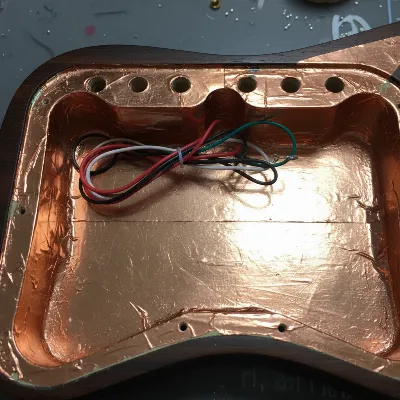 Electric guitar control cavity shielded with copper tape, wiring neatly arranged, ready for components.
3. Inspect Your Cables and Pedals
Faulty cables and improper pedalboard setups are notorious sources of hum. Start by testing different instrument cables. A damaged or poorly shielded cable can easily introduce noise [cite: 2, 5 (search 1)]. Ensure all cables are securely plugged into your guitar, pedals, and amplifier. For pedalboards, especially those with multiple digital effects, using an isolated power supply is highly recommended. Many cheap or daisy-chained power supplies can create ground loops or introduce power supply noise, causing hum in your signal chain [cite: 2 (search 3)]. If you suspect a pedal, try removing it from the chain or powering it with a fresh battery to see if the hum disappears.
4. Adjust Your Pickup Height
Sometimes, simply adjusting your pickup height can reduce unwanted noise. If your pickups are set too close to the strings, they can sometimes become microphonic (picking up mechanical vibrations or ambient noise) or even pick up more interference from the magnetic fields of your amplifier’s transformers. Experiment with lowering your pickups slightly. While primarily adjusted for tone and output balance, a subtle adjustment can sometimes mitigate hum or harshness. Make small, incremental changes and listen for improvements.
5. Consider a Hum-Cancelling Solution
If the above DIY steps don’t fully resolve the hum, especially with single-coil guitars, or if you play in very noisy environments, dedicated hum-cancelling solutions can be highly effective.
- Noise Gate Pedal: A noise gate automatically mutes your signal when it drops below a certain threshold, effectively cutting out hum and hiss when you’re not playing [cite: 3 (search 1)]. While useful, be mindful that aggressive settings can “chop off” sustain or affect your natural playing dynamics.
- Upgrade to Humbuckers or Noiseless Single-Coils: If your guitar has standard single-coil pickups and hum is a constant battle, consider replacing them with humbuckers or specialized noiseless single-coil pickups. These are designed to maintain a single-coil-like tone while effectively cancelling hum.
- Power Conditioner: For gigging musicians facing “dirty” power at venues, a power conditioner can filter out electrical interference and provide a stable power supply, significantly reducing hum from external sources [cite: 2 (search 1)].
When to Take Your Guitar to a Professional Repair Technician
While many hum issues can be resolved with DIY fixes, there are times when professional intervention is necessary. If you’ve tried all the troubleshooting steps and the hum persists, or if you’re uncomfortable dealing with soldering, complex wiring, or the internal components of an amplifier (which can be dangerous due to high voltage), it’s best to consult an experienced guitar technician or an amp repair specialist. They possess the tools and expertise to diagnose deeper electrical faults, repair cold solder joints, replace faulty components, or address complex grounding issues that might be beyond the scope of a home repair.
Electric Guitar Maintenance and Cleaning
Proper maintenance and regular cleaning are not only vital for preserving your electric guitar’s appearance and playability but also play a significant role in preventing common issues like unwanted hum. A well-maintained instrument is inherently less prone to electrical anomalies.
How to Maintain Your Electric Guitar to Increase Longevity
- Maintain Stable Humidity: Store your guitar in a stable environment, ideally within its case, to protect it from extreme temperature and humidity fluctuations. This prevents wood warping and potential stress on electronic components.
- Protect from Impacts: Always store your guitar securely, either in a stand away from foot traffic or, preferably, in a hard case when not in use or during transport.
- Regular Cleaning: Wipe down your guitar after each playing session to remove sweat and grime from strings, fretboard, and body. This prevents corrosion and buildup that can affect electronics.
Proper Electric Guitar Cleaning Steps
Regular cleaning can prevent many issues that might lead to hum:
- Clean Strings and Neck: Use a string cleaner and a soft cloth to wipe down strings. For the fretboard, especially unfinished ones (like rosewood or ebony), use a specialized fretboard conditioner periodically to keep the wood from drying out.
- Clean the Body: Use a guitar-specific polish or cleaner with a microfiber cloth for the body. Avoid harsh chemical cleaners that can damage the finish.
- Check and Clean Electronic Components: Periodically check that all nuts on potentiometers and the output jack are tight. If you notice crackling or intermittent sound when turning knobs, they might be dirty. A small amount of contact cleaner (specifically designed for electronics) sprayed into the pots can often resolve this, but consult a technician if you’re unsure. Loose connections or dirty pots can be direct sources of hum.
Recommended Electric Guitar Maintenance and Cleaning Products
- Guitar Cleaning Kit: Kits often include polish, string cleaner, and microfiber cloths.
- Fretboard Oil: Essential for conditioning unfinished fretboards.
- Microfiber Cloths: Ideal for cleaning all surfaces without scratching.
- Electronic Contact Cleaner: For dirty pots and switches, use sparingly and only if you know how to safely access the components.
By incorporating these maintenance habits, you not only prolong the life and beauty of your electric guitar but also actively contribute to a quieter, hum-free playing experience. Clean components and secure connections mean less opportunity for stray electrical signals to introduce unwanted noise into your cherished tone. Electric guitar cleaning kit with polish, cloth, and string cleaner for maintenance.
Conclusion
An annoying hum can significantly detract from the pleasure and quality of playing an electric guitar, transforming inspiring riffs into a buzzing frustration. As we’ve explored, the sources of this unwanted noise are varied, ranging from inherent single-coil characteristics and electromagnetic interference to faulty grounding, worn cables, or suboptimal power conditions. However, with a foundational understanding of your instrument’s anatomy and the surrounding electrical environment, many of these issues are surprisingly approachable.
Implementing the five quick DIY fixes—checking your grounding and power, diligently shielding your guitar’s cavities, inspecting your cables and pedals, adjusting pickup height, and considering dedicated hum-cancelling solutions like noise gates or humbuckers—can often lead to a dramatically quieter and more enjoyable playing experience. Regular maintenance and proper care also go a long way in preventing these issues from arising in the first place. Don’t let hum dictate your tone; empower yourself with knowledge and simple solutions. What steps will you take today to achieve a hum-free electric guitar tone?

I tried a few of these fixes for my Les Paul, mainly checking the cables and the amp chain. While it helped a little, the hum is still there, just not as loud. I was hoping for a complete fix, but it seems my issue might be more internal. Still, it gave me a good starting point for troubleshooting.
Fantastic advice! My cheap practice amp was always buzzing, and I just assumed it was the amp itself. Turns out, it was a faulty ground in my wall outlet, just like mentioned. After getting that sorted, my tone is so much cleaner. Really appreciate the detailed breakdown of common causes.
This guide was a lifesaver! My Stratocaster had this annoying 60-cycle hum that was driving me crazy during practice. I followed the advice about checking my power sources and sure enough, one of my pedals was on a dodgy extension cord. Switched it out and the hum is practically gone. So glad I didn’t have to take it to a tech.
Good tips here. I’ve always struggled with EMI, especially with my older single-coil guitars. The suggestion to shield cavities is something I’ve been meaning to do, and this reminded me to finally get around to it. It’s made a noticeable difference, though not a complete silence, which I guess is just part of the single-coil charm.