Perfectly intonating your electric guitar at home ensures every note on your fretboard rings true, from open strings to high frets. This process involves adjusting each string’s saddle at the bridge to match the open string’s pitch with its 12th-fret note, typically requiring a chromatic tuner and a small screwdriver. Achieving proper intonation significantly enhances playability and harmonic accuracy, transforming your playing experience.
Understanding Electric Guitar Intonation and its Evolution
Intonation refers to the precise adjustment of each string’s vibrating length so that notes played across the entire fretboard are in tune. It ensures that the note fretted at the 12th fret is exactly one octave higher than the open string, and that this relationship holds true up and down the neck. Without proper intonation, your guitar might be perfectly in tune when playing open chords, but sound sharp or flat as you move up the neck, leading to dissonant chords and solos.
The journey towards precise intonation began with the electric guitar’s rise in popularity. Early guitar designs had fixed bridges, making accurate intonation challenging. As guitarists pushed the boundaries of sound and technique, the demand for instruments that played perfectly in tune at every position grew. This led to the innovation of adjustable bridges, where each string’s saddle could be moved independently to fine-tune its speaking length. This advancement revolutionized playability, allowing for the complex harmonic structures and extended ranges prevalent in modern music. For shop curated electric guitar on this site.
Common Electric Guitar Bridge Types and Their Intonation Mechanisms
While the fundamental principle of intonation remains consistent, electric guitars feature various bridge designs, each with its own method for adjusting string length. Understanding these common types will help you identify how to access and manipulate the saddles on your specific instrument.
Hardtail and Strat-style Bridges
These bridges typically feature individual saddles for each string, each with its own adjustment screw. Hardtail bridges, fixed directly to the guitar body, offer excellent tuning stability. Stratocaster-style tremolo bridges, whether vintage six-screw or modern two-point, also use individual saddles that can be moved forward or backward to adjust intonation. These are generally straightforward to work with, requiring a small Phillips head or flathead screwdriver.
Tune-o-matic Bridges
Common on Gibson-style guitars like Les Pauls and SGs, Tune-o-matic bridges have a separate tailpiece and bridge. Each string passes over its own saddle, which can be adjusted using a screw at the back of the bridge. The saddles are often oriented to compensate for string thickness, with the bass strings needing longer vibrating lengths. These are also adjusted with a small screwdriver.
Tremolo Systems (e.g., Floyd Rose)
|
Our Picks for the Best Electric Guitar in 2026
As an Amazon Associate I earn from qualifying purchases.
|
||
| Num | Product | Action |
|---|---|---|
| 1 | Fender Mini Stratocaster Electric Guitar Kit, Beginner Guitar Kit, with 2-Year Warranty, with Frontman 10G Amp, Padded Gig Bag, Strap, Cable, Tuner, and Picks, Daphne Blue |

|
| 2 | Jackson Dinky Minion JS1X Electric Guitar - Black |
|
| 3 | RockJam Electric Guitar Kit with 10-Watt Amp, Gig Bag, Picks, Spare Strings & Lessons |
|
| 4 | STRICH Electric Guitar Beginner Kit, Solid Body 39" Full Size Electric Guitar HSS Pick Up for Starter, with 10W Amp, Bag, Digital Tuner, Capo, Strap, String,Cable, Picks, SST-S20 Sapphire Blue |
|
| 5 | 16inch Mini Guitar Toy for Kids and Beginners, Electric Guitar with Strap for Toddlers and Boys and Girls Instrument Toys |
|
| 6 | 39 Inch Electric Guitar Bag 7mm Padding Waterproof Electric Guitar Case, Electric Guitar Gig Bag Backpack with Neck Strap and Pockets, Black |
|
| 7 | Ibanez GRG131DX - Black Flat |
|
| 8 | Tostar 39 Inch Full Size Electric Guitar Kit For Beginners And Adults,SSS Pickup Stratocaster Guitarra Electrica Set Includes Tremolo Bridge,Amp,Strings,Stand,Case Bag, Birthday Holiday Gifts, Red |
|
| 9 | WINZZ EGM100 30 Inches Real Kids Electric Guitar with Beginner Kit, Right Handed (Gradient Pink) |
|
| 10 | LyxPro 39 inch Electric Guitar Kit Bundle with 20w Amplifier, All Accessories, Digital Clip On Tuner, Six Strings, Two Picks, Tremolo Bar, Shoulder Strap, Case Bag Starter kit Full Size - Blue |
|
High-performance locking tremolo systems, such as the Floyd Rose, offer extreme pitch manipulation but also require a more intricate intonation process. On these bridges, the string is clamped at the nut and the bridge. Intonation is typically adjusted by loosening a locking screw on each saddle, moving the saddle, and then retightening. This often requires an Allen wrench in addition to a screwdriver. Despite their complexity, the goal remains the same: adjusting saddle position to match open and fretted pitches.
The Essential Components of Electric Guitar Intonation
While intonation directly involves the bridge saddles, several other parts of your electric guitar play a crucial, albeit indirect, role in maintaining stable and accurate tuning across the fretboard. A holistic understanding of these components ensures your intonation adjustments are long-lasting and effective.
The Neck’s Role in Intonation Stability
The guitar neck, with its truss rod, is fundamental. Proper neck relief—the slight forward bow of the neck—is essential. If the neck is too straight or has too much relief, it can alter the string tension and pitch, especially when fretting notes, making consistent intonation impossible. A well-adjusted truss rod ensures the neck provides a stable foundation for consistent string vibration.
Bridges and Saddles: The Core of Intonation
The bridge saddles are where the magic of intonation truly happens. These small, adjustable components determine the exact speaking length of each string. By moving a saddle closer to or further from the nut, you effectively shorten or lengthen that string’s vibrating portion, thereby adjusting its pitch at various fret positions. Most saddles are metal, providing a clear, defined contact point for the string. Their design allows for individual string adjustment, which is critical because each string, due to its unique gauge and tension, requires a slightly different vibrating length to intonate correctly.
Other Critical Elements
The nut, located at the headstock end of the fretboard, sets the starting point for each string’s vibrating length. A poorly cut nut can cause tuning issues and affect open string intonation. Tuners (machine heads) on the headstock are responsible for accurate initial tuning; stable tuners are vital before beginning intonation adjustments. Finally, string gauge has a significant impact; changing to a different set of strings with a different gauge will almost certainly throw off your intonation, necessitating a full readjustment. Using fresh, properly stretched strings is always the first step.
Preparing Your Electric Guitar for Intonation
Before you even touch a screwdriver, proper preparation is key to successful intonation. Skipping these preliminary steps can lead to frustration and inaccurate results, forcing you to start over. Think of it as laying a solid foundation before building a house; without it, the whole structure might be unstable.
Gathering Your Tools
To intonate your electric guitar, you’ll need a few essential items. First and foremost, an accurate chromatic tuner is indispensable. Digital pedal tuners or high-quality clip-on tuners are ideal. Avoid phone app tuners unless you’ve verified their precision. You’ll also need the appropriate small screwdriver(s) for your bridge saddles – typically a small Phillips head or flathead. If your guitar has a locking tremolo system, you may need specific Allen wrenches. Finally, ensure you have a new set of strings ready to install.
Fresh Strings and Proper Tuning
One of the most common reasons for poor intonation is old, worn-out strings. Old strings lose their vibrational integrity and elasticity, making accurate intonation impossible. Always start with a brand-new set of your preferred gauge and type. Install them carefully, stretch them thoroughly, and then tune your guitar to your desired standard (e.g., E Standard). Ensure the guitar holds its tune reliably before proceeding. Any tuning instability will lead to inaccurate intonation.
Setting Neck Relief (Truss Rod Adjustment)
Before intonating, check and adjust your neck relief. The neck should have a slight, almost imperceptible forward bow. To check, fret a string at the first fret and simultaneously at the fret where the neck meets the body (usually the 17th fret or higher). Look at the gap between the bottom of the string and the top of the frets around the 7th-9th fret. There should be a tiny gap, roughly the thickness of a business card. If the neck is completely flat or bowed backward, or excessively bowed forward, adjust the truss rod accordingly. (Note: Truss rod adjustments can be delicate; if unsure, consult a professional).
Adjusting String Action (Height)
Once your neck relief is set, adjust your string action (the height of the strings above the fretboard). String action significantly impacts intonation because pressing a string down to a fret slightly stretches it. Higher action means more stretching, which can pull the note sharp. Adjust your bridge’s overall height and individual saddle heights to your preferred playing comfort and feel. Ensure there’s no fret buzz, but also avoid excessively high action that could compromise intonation.
Step-by-Step Guide to Perfect Electric Guitar Intonation
With your guitar properly prepared, you’re ready to dive into the precise art of intonation. This process requires patience and attention to detail, but with each string you adjust, you’ll hear a noticeable improvement in your guitar’s overall playability and harmony.
The 12th Fret Method
The most common and effective method for intonating an electric guitar involves comparing the pitch of the open string to the pitch of the note fretted at the 12th fret.
- Tune the Open String: Start with the low E string. Pluck it open and tune it perfectly using your chromatic tuner.
- Check the 12th Fret: Gently fret the low E string at the 12th fret (don’t press too hard, as excessive pressure can bend the pitch sharp) and pluck it. Observe your tuner.
- Compare Pitches:
- If the 12th-fret note reads sharp (higher pitch) compared to the open string, the string’s vibrating length is too short.
- If the 12th-fret note reads flat (lower pitch) compared to the open string, the string’s vibrating length is too long.
- If they match perfectly, that string is correctly intonated.
Alternatively, some prefer to compare the open string to the 12th-fret harmonic. To do this, lightly touch the string directly over the 12th fret wire (without pressing down) and pluck it to sound the harmonic. Then, compare this harmonic pitch to the fretted 12th-fret note. This method accounts for any potential issues with fretting pressure. However, for most home setups, comparing the open string to the fretted 12th-fret note is sufficiently accurate.
Mastering Saddle Adjustments: Sharp vs. Flat
Based on your 12th-fret check, you’ll need to adjust the bridge saddle for that string. Follow these rules:
- Fretted Note is Sharp: If your 12th-fret note is sharp, you need to lengthen the string. To do this, use your screwdriver to move the saddle backward, away from the neck/nut. This increases the vibrating length of the string.
- Fretted Note is Flat: If your 12th-fret note is flat, you need to shorten the string. To do this, move the saddle forward, towards the neck/nut. This decreases the vibrating length of the string.
Make small adjustments at a time. A quarter-turn of the screw can make a significant difference.
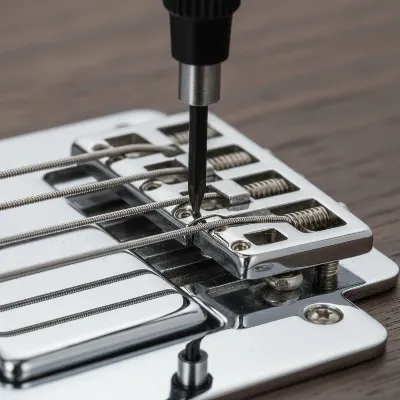 Close-up of an electric guitar bridge saddle being adjusted for intonation with a small screwdriver, showing the screw and saddle movement.
Iteration and Refinement
After each adjustment to a saddle, you must retune the open string perfectly before rechecking the 12th-fret note. Moving the saddle slightly changes the string tension, which in turn alters the open string’s pitch. This is a crucial step that many beginners overlook.
The process is iterative:
- Tune open string.
- Check 12th fret.
- Adjust saddle.
- Retune open string.
- Recheck 12th fret.
Repeat this cycle for each string until the open string and the 12th-fret note/harmonic match perfectly on your tuner. It might take several passes per string to achieve precision. Work your way from the low E string to the high E string, as adjustments on one string can sometimes subtly affect its neighbors.
Addressing Challenging Bridge Designs
Some electric guitars, particularly vintage-style Telecasters, feature bridges with only three saddles for six strings, meaning two strings share one saddle. In these cases, achieving perfect intonation for every single string is a physical impossibility. You’ll need to make a slight compromise. Intonate each pair of strings on a shared saddle to achieve the best possible average intonation for both, aiming for a point where neither string is excessively sharp or flat. Modern Telecaster bridges often feature individual saddles, eliminating this compromise.
Troubleshooting Common Intonation Issues
Even with careful execution, you might encounter issues that prevent your electric guitar from intonating perfectly. Understanding these common problems can help you diagnose and resolve them, ensuring your hard work pays off.
One frequent culprit is old or improperly installed strings. As mentioned, old strings don’t vibrate consistently, making accurate intonation impossible. Ensure your strings are new, stretched properly, and seated correctly in the nut and bridge saddles. Sometimes, strings can get caught in the nut slots, causing binding and tuning instability. A little graphite in the nut slots can help here.
Worn or uneven frets can also be a major intonation killer. If your frets are grooved, flat-spotted, or simply not level, they can cause notes to fret out incorrectly or go sharp/flat. This is a job for a professional luthier, as it often requires fret leveling, crowning, or even a refret. Similarly, a damaged or poorly cut nut can also throw off intonation, particularly on the open strings and lower frets.
Another factor is the string gauge itself. If you significantly change your string gauge (e.g., from light .009s to heavy .011s), the increased tension will drastically alter the neck relief and string action, necessitating a full setup re-evaluation before intonation. Cheap or faulty tuners can make it impossible to get the open string accurately tuned, rendering intonation adjustments moot.
Finally, environmental changes like fluctuations in temperature and humidity can cause the guitar’s wood to expand or contract, affecting neck relief and intonation. This is why periodic checks are necessary, especially if your guitar is exposed to varying conditions. Sometimes, despite your best efforts, a guitar’s physical limitations (like those shared Telecaster saddles) might mean you can only achieve a “good enough” intonation rather than absolute perfection.
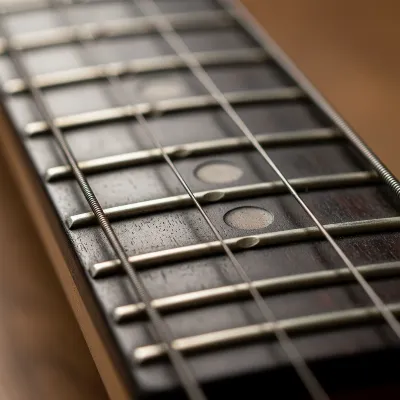 Close-up of an electric guitar fretboard showing worn frets that can cause intonation problems.
Maintaining Your Electric Guitar’s Optimal Intonation
Intonating your electric guitar is not a one-time fix; it’s an ongoing aspect of instrument care. Regular maintenance ensures your guitar continues to play beautifully in tune, providing you with a consistent and enjoyable playing experience.
The most crucial aspect of maintaining intonation is periodic checking. Whenever you change your strings, it’s a good practice to check your intonation, even if you’re using the same gauge. New strings need time to stretch and settle, and once they do, a slight intonation tweak might be necessary. It’s also wise to check intonation a few times a year, especially if you live in an environment with significant seasonal temperature and humidity changes. These environmental shifts can cause the guitar’s wood to move, subtly altering the neck relief and potentially throwing off your intonation.
Beyond just checking, keeping your bridge area clean is important. Dust, grime, and corrosion can build up around the saddles, potentially hindering their free movement or creating inconsistent contact points for the strings. A quick wipe-down during string changes can prevent these issues. Ensure all the small screws and springs associated with your bridge (especially on tremolo systems) are in good working order. Loose or missing components can affect stability and intonation.
Proper string changing technique also contributes to intonation stability. Ensure strings are wrapped neatly and securely around the tuning posts and that they are stretched out adequately before tuning to pitch. This helps them settle faster and maintain consistent tension. An intonated guitar is a happy guitar, and a happy guitar encourages more playing!
Conclusion
Mastering how to intonate your electric guitar at home is a skill that empowers you to unlock your instrument’s full potential. By understanding what intonation is, gathering the right tools, and meticulously following the step-by-step process of adjusting each string’s saddle, you can achieve a level of tuning accuracy that will significantly enhance your playing and listening experience. Prioritize proper guitar setup, including fresh strings, neck relief, and action, before diving into intonation adjustments. It’s an iterative process that demands patience, but the reward of a perfectly in-tune instrument across every fret is immeasurable. So, grab your tuner and screwdriver, and take control of your guitar’s voice. What will you play first now that your guitar sings in perfect harmony?
Frequently Asked Questions
Why does my guitar’s intonation keep changing?
Your guitar’s intonation can shift due to several factors, including changing string gauges, worn-out strings, environmental changes (temperature and humidity affecting wood), and even slight changes in neck relief or string action. Regular checks, especially with string changes, help maintain accuracy.
Can I intonate my guitar without a professional tuner?
While a highly accurate chromatic tuner is recommended for the best results, you can use a good quality digital pedal tuner or a reliable clip-on tuner. Phone app tuners can be used, but their accuracy might vary depending on your phone’s microphone and the app’s calibration.
How often should I check my guitar’s intonation?
It’s advisable to check your electric guitar’s intonation every time you change strings, especially if you’re using a different brand or gauge. A general check every few months, or whenever you notice your guitar sounding out of tune up the neck, is a good practice.
Does string gauge affect intonation?
Yes, string gauge significantly affects intonation. Different string gauges have different tensions and vibrational characteristics, which alter the necessary vibrating length for accurate intonation. Always re-intonate your guitar after changing to a different string gauge.
What if I can’t get a string perfectly intonated?
If a string can’t be perfectly intonated, it could indicate underlying issues such as extremely worn frets, a faulty nut, a bent neck, or physical limitations of the bridge design (e.g., three-saddle Telecaster bridges). In such cases, consulting a professional guitar technician is recommended.
Is intonation the same for all electric guitars?
The principle of intonation (matching open and 12th-fret pitches) is the same for all electric guitars. However, the method of adjustment varies depending on the bridge type (e.g., hardtail, tremolo, Floyd Rose), each requiring specific tools and approaches to move the saddles.
Frequently Asked Questions
Why does my electric guitar's intonation keep changing?
Your guitar's intonation can shift due to several factors, including changing string gauges, worn-out strings, and environmental changes like temperature and humidity affecting the wood. Regular checks, especially with string changes, help maintain accuracy.
Can I intonate my electric guitar without a professional tuner?
While a highly accurate chromatic tuner is recommended for the best results, you can use a good quality digital pedal tuner or a reliable clip-on tuner. Phone app tuners can be used, but their accuracy might vary depending on your phone's microphone and the app's calibration.
How often should I check my electric guitar's intonation?
It's advisable to check your electric guitar's intonation every time you change strings, especially if you're using a different brand or gauge. A general check every few months, or whenever you notice your guitar sounding out of tune up the neck, is a good practice.
Does changing string gauge affect electric guitar intonation?
Yes, string gauge significantly affects intonation. Different string gauges have different tensions and vibrational characteristics, which alter the necessary vibrating length for accurate intonation. Always re-intonate your guitar after changing to a different string gauge.
What if I cannot get a string perfectly intonated on my guitar?
If a string cannot be perfectly intonated, it could indicate underlying issues such as extremely worn frets, a faulty nut, a bent neck, or physical limitations of the bridge design (e.g., three-saddle Telecaster bridges). In such cases, consulting a professional guitar technician is recommended.
Is the intonation process the same for all electric guitar types?
The principle of intonation (matching open and 12th-fret pitches) is the same for all electric guitars. However, the method of adjustment varies depending on the bridge type (e.g., hardtail, tremolo, Floyd Rose), each requiring specific tools and approaches to move the saddles.
Perfectly Intonate Your Electric Guitar at Home
This guide provides a step-by-step process to accurately intonate your electric guitar, ensuring every note on the fretboard is in tune. Proper intonation enhances playability and harmonic accuracy.
Install a new set of strings, stretch them thoroughly, and tune your guitar to your desired standard (e.g., E Standard) using an accurate chromatic tuner. Ensure neck relief and string action are properly set before proceeding. Gather a small Phillips head or flathead screwdriver, and Allen wrenches if you have a locking tremolo system.
Start with the low E string. Pluck it open and tune it perfectly using your chromatic tuner. Then, gently fret the low E string at the 12th fret and pluck it, observing your tuner to compare its pitch to the open string. If the 12th-fret note is sharp, the string's vibrating length is too short; if flat, it's too long.
If the 12th-fret note is sharp, lengthen the string by moving the saddle backward, away from the neck/nut, using your screwdriver. If the 12th-fret note is flat, shorten the string by moving the saddle forward, towards the neck/nut. Make small adjustments, typically a quarter-turn of the screw at a time.
After each saddle adjustment, you must retune the open string perfectly before rechecking the 12th-fret note. Repeat the cycle of tuning the open string, checking the 12th fret, adjusting the saddle, and retuning until the open string and 12th-fret note match perfectly on your tuner. Work from the low E string to the high E string.
For guitars with shared saddles (e.g., vintage Telecasters), achieving perfect intonation for every string might be impossible. Intonate each pair of strings on a shared saddle to achieve the best possible average intonation, aiming for a point where neither string is excessively sharp or flat. Modern bridges with individual saddles eliminate this compromise.

Wow, what a game changer! I never realized how much proper intonation affected my playing experience. My chords sound so much cleaner now, and even my solos feel more accurate. All it took was a small screwdriver and my tuner, just like it said. Every guitarist should know how to do this.
I tried to intonate my electric guitar using these steps, and while it helped a bit, I still had some trouble getting my low E string perfectly in tune at the higher frets. I think my old chromatic tuner might not be precise enough, or maybe my bridge is just a bit worn out. It’s better than before, but not quite perfect.
This guide was super helpful for understanding how to adjust the saddles at the bridge. I used to just tune my open strings and hope for the best, but now I get why the 12th fret note is so important. It took me a little longer than I expected to get each string perfect, but the improvement in playability is definitely worth the effort.
I’ve always struggled with getting my guitar to sound right all the way up the neck, especially after changing string gauges. Following these steps to intonate my electric guitar at home made a huge difference. My 12th fret notes finally ring true, and it’s like playing a whole new instrument. Highly recommend giving this a try if your guitar sounds off.