Fret buzz on an electric guitar, characterized by an irritating metallic rattle, can often be diagnosed and fixed at home with basic tools and patience. This common issue arises when a vibrating string makes unwanted contact with a fret wire, typically due to an imbalance in the guitar’s setup, such as incorrect neck relief, low string action, or worn components. Addressing these factors can restore clear, resonant tones to your instrument.
Electric Guitar: Understanding Fret Buzz in Modern Playability
Electric guitars have revolutionized music, becoming indispensable tools across countless genres since their inception in the 1930s. From the early “Frying Pan” lap steel to today’s sophisticated instruments, their evolution has consistently pushed the boundaries of sound and expression. The very nature of an electric guitar’s design, with its low action and precise setup requirements, makes it susceptible to fret buzz. This annoying phenomenon occurs when a vibrating string makes unwanted contact with a fret wire, creating a buzzing sound instead of a clear tone. It’s often a symptom of an imbalance in the guitar’s delicate equilibrium, influenced by factors from environmental changes to playing style. Understanding this fundamental relationship between guitar setup and performance is key to maintaining optimal playability and a buzz-free experience.
Common Electric Guitar Designs and Their Fret Buzz Considerations
While there are numerous electric guitar designs, certain construction elements can influence their susceptibility to or ease of addressing fret buzz. The two most common bridge types, fixed (like a Tune-O-Matic) and tremolo (like a Fender-style vibrato), often dictate the approach to string height adjustments. Guitars with fixed bridges typically offer individual saddle height adjustment screws for each string, allowing for fine-tuning to eliminate localized buzz. Tremolo systems, while offering expressive pitch modulation, can sometimes contribute to buzz if not properly set up, requiring careful attention to spring tension and overall bridge height. Similarly, the neck joint (bolt-on, set-neck, or neck-through) and overall build quality can affect neck stability, a critical factor in maintaining consistent fret leveling and relief, which directly impacts the likelihood of fret buzz. For see our electric guitar recommendations on this site.
Detailed Anatomy of an Electric Guitar and Fret Buzz Causes
Understanding the individual components of your electric guitar is crucial for diagnosing and fixing fret buzz. Each part plays a role in the instrument’s overall setup and can be a source of unwanted noise.
Body: Wood Types and Their Influence
The body of an electric guitar, often crafted from woods like Alder, Ash, Mahogany, or Maple, primarily influences tone and sustain. While the body itself rarely causes fret buzz directly, its stability can impact the neck’s attachment and overall structural integrity. A stable body contributes to a reliable foundation for neck and bridge adjustments.
Neck: Woods, Shapes, and Playability
|
Our Picks for the Best Electric Guitar in 2026
As an Amazon Associate I earn from qualifying purchases.
|
||
| Num | Product | Action |
|---|---|---|
| 1 | STRICH Electric Guitar Beginner Kit, Solid Body 39" Full Size Electric Guitar HSS Pick Up for Starter, with 10W Amp, Bag, Digital Tuner, Capo, Strap, String,Cable, Picks, SST-S20 Sapphire Blue |

|
| 2 | Fender Mini Stratocaster Electric Guitar Kit, Beginner Guitar Kit, with 2-Year Warranty, with Frontman 10G Amp, Padded Gig Bag, Strap, Cable, Tuner, and Picks, Daphne Blue |
|
| 3 | Jackson Dinky Minion JS1X Electric Guitar - Black |
|
| 4 | WINZZ EGM100 30 Inches Real Kids Electric Guitar with Beginner Kit, Right Handed (Gradient Pink) |
|
| 5 | RockJam Electric Guitar Kit with 10-Watt Amp, Gig Bag, Picks, Spare Strings & Lessons |
|
| 6 | Tostar 39 Inch Full Size Electric Guitar Kit For Beginners And Adults,SSS Pickup Stratocaster Guitarra Electrica Set Includes Tremolo Bridge,Amp,Strings,Stand,Case Bag, Birthday Holiday Gifts, Red |
|
| 7 | 39 Inch Electric Guitar Bag 7mm Padding Waterproof Electric Guitar Case, Electric Guitar Gig Bag Backpack with Neck Strap and Pockets, Black |
|
| 8 | LyxPro 39 inch Electric Guitar Kit Bundle with 20w Amplifier, All Accessories, Digital Clip On Tuner, Six Strings, Two Picks, Tremolo Bar, Shoulder Strap, Case Bag Starter kit Full Size - Blue |
|
| 9 | Ibanez GRG131DX - Black Flat |
|
| 10 | 16inch Mini Guitar Toy for Kids and Beginners, Electric Guitar with Strap for Toddlers and Boys and Girls Instrument Toys |
|
The neck, typically made of Maple or Mahogany, is central to fret buzz. Its relief (the slight forward bow) is critical. If the neck is too straight or back-bowed (convex), strings will buzz against lower frets. If there’s too much forward-bow (concave), the action might be too high, potentially causing buzz in the middle of the neck if the string doesn’t have enough clearance. Neck shape (e.g., C-shape, D-shape, V-shape) affects comfort and playability but not directly fret buzz. However, a neck that warps due to environmental changes is a primary culprit.
Pickups: Types and Sound Influence
Pickups (Single-coil, Humbucker, P90) translate string vibrations into an electrical signal. While they define your guitar’s tone, overly high pickups can cause fret buzz. The magnets in pickups exert a pull on the strings, and if set too close, this magnetic pull can interfere with string vibration, leading to buzz or poor intonation.
Bridge: Types, Adjustment, and Sustain
The bridge is where strings anchor and string height (action) is set. Fixed bridges (like Tune-O-Matic) and tremolo systems (like Fender-style) allow for individual string saddle adjustments. If the saddles are set too low, the strings won’t have enough room to vibrate freely, resulting in buzz, especially when played aggressively. Loose bridge components can also vibrate, mimicking fret buzz.
Other Components: Tuners, Nut, Volume/Tone Controls
Tuners ensure stable tuning but don’t typically cause buzz unless loose and rattling. The nut, located at the headstock end of the neck, is critical for open string buzz. If the nut slots are cut too deep or worn down, open strings will buzz against the first fret. Volume and tone controls are electronic and not directly related to mechanical buzz, but ensuring all hardware is secure prevents extraneous rattles.
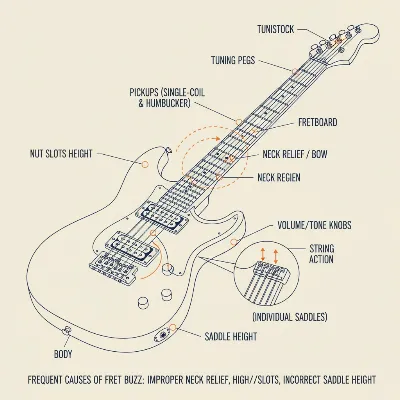 Detailed diagram of an electric guitar highlighting parts related to fret buzz like neck, frets, nut, and bridge
Factors in Electric Guitar Design Affecting Fret Buzz
When considering electric guitar brands, it’s less about which brand inherently “buzzes” more, and more about consistent build quality, fretwork, and the design’s inherent adjustability that prevents or allows for easy correction of fret buzz.
| Feature / Brand Tendency | Description Relevant to Fret Buzz | Example Brands/Models |
|---|---|---|
| Fret Leveling & Quality | High-quality fretwork with level frets is paramount for preventing buzz, allowing for lower action without issues. Inconsistent fretwork can lead to high spots causing localized buzz. | PRS, higher-end Fender/Gibson |
| Neck Stability | Necks that resist warping due to environmental changes maintain proper relief more consistently, reducing the need for frequent truss rod adjustments. | Maple necks often cited for stability; some modern designs |
| Bridge Adjustability | Bridges with individual saddle height adjustment offer more precise control over string action, making it easier to eliminate string-specific buzz. | Fender Strat/Tele, many modern multi-saddle designs |
| Nut Quality | Well-cut nuts made from durable materials (bone, Tusq) provide consistent string height and prevent open string buzz. Poorly cut or soft plastic nuts can wear quickly. | Custom-built, higher-end guitars |
| Setup from Factory | Reputable brands often provide better initial factory setups, reducing the likelihood of immediate fret buzz issues. | Gibson, Fender, Ibanez, ESP, PRS |
Brands like PRS are often lauded for their meticulous fretwork and consistent quality control, leading to guitars that can achieve very low action with minimal buzz. Fender and Gibson, across their various price points, offer designs that are generally very adjustable, allowing players or technicians to dial in a buzz-free setup. However, even guitars from top manufacturers can develop buzz over time due to environmental factors, wear, or changes in string gauge. The key takeaway is to look for brands known for good craftsmanship and ease of adjustment.
Buying an Electric Guitar: What to Check for Fret Buzz
When investing in a new electric guitar, a thorough inspection can save you from future fret buzz headaches. Even a brand-new instrument can exhibit buzz if not properly set up or if it has minor manufacturing flaws.
- Play Every Note: Strum each open string, then systematically play every note on every string, from the first fret all the way up the neck. Listen carefully for any buzzing. Pay attention to how aggressively you play; some very low action setups might buzz with a heavy attack but be fine with a lighter touch.
- Check Neck Relief: Hold the guitar in playing position. Fret the low E string at the 1st fret with one hand and at the last fret (where the neck meets the body) with the other. Look at the gap between the bottom of the string and the top of the 8th fret. You should see a very slight gap, roughly the thickness of a business card. No gap might indicate a back-bow, while a large gap could mean excessive relief. Repeat for the high E string.
- Inspect Fret Levelness: Visually sight down the neck from the headstock and from the bridge, looking for any frets that appear noticeably higher than their neighbors. While a precise fret rocker is ideal, you can get a good general idea. Run your finger along the frets to feel for any sharp edges or unevenness.
- Examine the Nut: Check the nut slots for proper depth. If the open strings sound buzzy but fretted notes are clear, the nut slots might be too low. Visually inspect for any wear or chips.
- Assess String Action: While subjective, generally you want the string height to be comfortable without being so low that it causes constant buzzing. Check the action at the 12th fret. Compare it to common action specifications (e.g., around 4/64″ for high E and 6/64″ for low E on electrics) to ensure it’s within a reasonable range.
- Listen for Loose Parts: Gently shake the guitar and listen for any rattles. Check that bridge saddles are secure, tuning pegs aren’t loose, and pickup covers are firmly in place. Sometimes, an apparent fret buzz is just a loose component resonating.
If you find significant fret buzz on a new guitar, ask the store to perform a professional setup before purchase, or consider another instrument.
Common Fret Buzz Issues and How to Fix Them
Fret buzz can stem from several sources, but many can be addressed with straightforward DIY adjustments. The key is to diagnose the specific type of buzz you’re experiencing.
1. Playing Technique
Sometimes, the buzz isn’t your guitar, it’s you!
- Insufficient Finger Pressure: Not pressing down hard enough on the strings, especially with barre chords, can cause strings to buzz against the frets.
- Fix: Practice applying firm, consistent pressure. Ensure your fingers are directly behind the fret, not in the middle of the fret space.
- Aggressive Picking/Strumming: Hitting the strings too hard can cause them to vibrate excessively, contacting the frets.
- Fix: Experiment with a lighter touch, or consider using heavier gauge strings which are less prone to over-vibration.
2. Worn or Dirty Strings
Old, corroded, or dirty strings can lose their evenness and vibrate erratically, causing buzz. Changing string gauge can also alter neck tension, affecting relief and potentially introducing buzz.
- Fix: Replace old strings with a fresh set. If you’ve recently changed gauges, the neck might need a slight truss rod adjustment to compensate for the new tension. Clean your fretboard regularly to prevent grime buildup that can interfere with string vibration.
3. Incorrect Neck Relief (Truss Rod Adjustment)
This is one of the most common causes of fret buzz, especially due to environmental changes (humidity, temperature).
- Symptoms:
- Back-Bow (Neck Too Straight/Convex): Buzz on open strings or in the first few frets. The strings are too close to the frets in the lower positions.
- Excessive Forward-Bow (Neck Too Concave): Less common for buzz, but can cause high action and potentially buzz higher up the neck if strings dip too much.
- How to Check:
- Tune your guitar to pitch.
- Place a capo on the 1st fret.
- Hold down the low E string at the fret where the neck meets the body (usually around the 17th fret).
- Observe the gap between the bottom of the low E string and the top of the 8th fret. A slight gap, about the thickness of a business card (0.010-0.012 inches or 0.25-0.30mm), is ideal.
- How to Fix (Truss Rod Adjustment):
- Locate the truss rod adjustment nut (either at the headstock or at the base of the neck).
- Use the correct Allen key or wrench.
- For Back-Bow (buzz on lower frets): Loosen the truss rod by turning it counter-clockwise in small increments (1/8 to 1/4 turn). This adds more forward relief.
- For Excessive Forward-Bow (if buzz occurs higher on the neck due to uneven string plane): Tighten the truss rod by turning it clockwise in small increments. This straightens the neck.
- Tune the guitar and let the neck settle for 5-10 minutes before re-checking the relief and making further adjustments. Never force the truss rod. If it’s too tight or won’t move, seek professional help.
4. Low String Action (Bridge Saddle Adjustment)
If your strings are set too close to the frets, even with proper neck relief, they can buzz.
- Symptoms: Buzzing occurs consistently across multiple frets, particularly when playing harder.
- How to Fix (Bridge Saddle Adjustment):
- Fender-style bridges (individual saddles):
- Identify the buzzing string(s).
- Use a small Allen key (usually 1.5mm) to turn the two adjustment screws on the saddle clockwise to raise the string height. Turn both screws equally to keep the saddle level.
- Raise in small increments, test, and re-tune until the buzz disappears.
- Tune-O-Matic bridges (Gibson-style):
- Slightly loosen all strings to relieve tension on the bridge.
- Turn the thumbwheels on each side of the bridge clockwise to raise the overall bridge height.
- Raise equally on both sides to maintain the bridge’s level.
- Tune, test, and re-tune.
- “Often, a quick fix to eliminate guitar fret buzz is to raise the string action height as long as you can keep it comfortable to play.”
- Fender-style bridges (individual saddles):
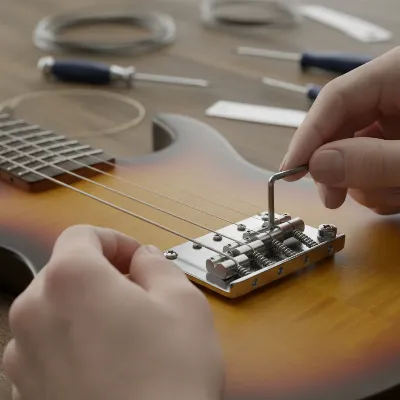 A person’s hands adjusting the bridge saddles on an electric guitar with an Allen key to fix fret buzz
5. Worn or Improperly Cut Nut Slots
The nut dictates the string height for open notes.
- Symptoms: Buzzing only on open strings, but not when fretted. This usually indicates that the nut slot for that string is too low or worn.
- How to Fix:
- Temporary Shim: Carefully remove the buzzing string from its nut slot. Place a tiny piece of paper or business card material (folded once or twice) at the bottom of the slot, then place the string back over it. Tune and test. This is a temporary diagnostic.
- Fill and Recut/Replace Nut: For a permanent fix, the nut slot needs to be filled (e.g., with super glue and bone dust/baking soda) and re-filed to the correct height and angle, or the entire nut needs to be replaced. This often requires specialized nut files and should be approached carefully, or left to a professional.
- “If the grooves in the nut aren’t cut correctly, or if the zero-fret has worn down, this can cause fret buzz.”
6. Uneven or High Frets
Individual frets can become uneven due to manufacturing inconsistencies, wear over time, or shifting fretboards.
- Symptoms: Localized buzz on specific frets or strings, even after checking neck relief and action.
- How to Diagnose: Use a fret rocker (a small, straight piece of metal with three different length edges) to check individual frets. Place it over three consecutive frets; if it rocks, the middle fret is high.
- How to Fix:
- Spot Leveling: For minor high spots, very careful spot leveling and crowning with specialized tools can fix it. This is an advanced DIY task.
- Professional Fret Leveling: For significant unevenness, a full fret level, crown, and polish by a qualified technician is usually required. This ensures all frets are perfectly level, allowing for optimal action.
7. Loose Components
Sometimes, the “fret buzz” isn’t from the frets at all, but a loose piece of hardware resonating.
- Symptoms: A general rattle or buzz that seems to come from the guitar but isn’t tied to specific notes or frets.
- How to Check: Play the guitar un-amplified. Gently tap around various components: bridge saddles, tuning machines, pickup covers, control knobs, strap buttons, and even internal wiring in the control cavity. Shake the guitar slightly.
- Fix: Tighten any loose screws, nuts, or components. Apply a tiny drop of clear nail polish to the threads of rattling screws (like saddle height screws) to secure them.
8. Pickup Height
If pickups are set too high, their magnetic pull can interfere with string vibration.
- Symptoms: Buzzing that may seem random or specific to certain strings, often accompanied by issues like poor sustain or intonation problems.
- Fix: Lower the pickups slightly using the adjustment screws on either side of the pickup. Start by turning them counter-clockwise by half a turn and test. Repeat until the buzz is gone or minimized.
Maintaining and Cleaning Your Electric Guitar to Prevent Fret Buzz
Regular maintenance is your best defense against fret buzz, extending the life and playability of your electric guitar.
How to Preserve Your Electric Guitar’s Lifespan
- Control Humidity: Wood is highly susceptible to changes in humidity. Keep your guitar in an environment with stable humidity (ideally 45-55% relative humidity) using a humidifier or dehumidifier as needed. Extreme changes can cause the neck to warp, leading to fret buzz.
- Store Properly: When not playing, store your guitar in a case or on a stand away from direct sunlight, heat sources, or extreme cold.
- Gentle Handling: Avoid dropping or knocking your guitar, which can cause frets to lift or shift, leading to buzz.
Proper Electric Guitar Cleaning Steps
A clean guitar isn’t just aesthetically pleasing; it can prevent issues like fret buzz.
- Wash Your Hands: Always wash your hands before playing to minimize transferring dirt and oils to strings and the fretboard.
- Wipe Down After Playing: After each session, wipe down your strings, fretboard, and body with a clean, soft microfiber cloth to remove sweat and grime. This prevents buildup that can dampen string vibration and accumulate under frets.
- Deep Clean Strings and Fretboard: Periodically (e.g., during string changes), give your strings and fretboard a more thorough cleaning.
- Strings: Use a dedicated string cleaner or a clean cloth dampened with rubbing alcohol (sparingly and carefully, avoiding contact with finished wood).
- Fretboard (Unfinished wood like Rosewood/Ebony): Use a specialized fretboard cleaner or lemon oil. Apply a small amount to a cloth and wipe the fretboard, then buff dry. Avoid using too much, and never use lemon oil on maple fretboards with a finish.
- Polish Frets: Over time, frets can become tarnished. Gently polishing frets (e.g., with fine steel wool, carefully masked off, or specialized fret polish) can improve playability and reduce string friction.
Recommended Maintenance Products
- Microfiber Cloths: Essential for daily wiping.
- String Cleaner: Extends string life and maintains tone.
- Fretboard Conditioner/Oil: For unfinished fretboards to prevent drying and cracking.
- Guitar Polish/Wax: For finished body parts to protect the finish.
- Humidity Control Packs: For in-case humidity regulation.
Conclusion
Fret buzz, while annoying, is a solvable problem for most electric guitarists. By understanding the common causes—from neck relief and string action to nut issues and playing technique—and applying the DIY solutions outlined here, you can often restore your guitar to its optimal playing condition. Remember to approach adjustments in small increments, allowing your guitar to settle, and always prioritize gentle handling. If a problem persists or feels beyond your comfort level, don’t hesitate to consult a professional guitar technician. A well-maintained and properly set up electric guitar is a joy to play, offering clear, resonant tones that truly inspire. So, grab your tools, and let’s get that electric guitar sounding its best – what’s the first adjustment you’ll make today?
Frequently Asked Questions
What is the most common cause of fret buzz on an electric guitar?
The most common causes are often related to improper neck relief (either too straight or too much bow) or low string action at the bridge saddles. Environmental changes like humidity fluctuations frequently cause the neck to shift, leading to these issues.
How much neck relief should an electric guitar have to avoid fret buzz?
Generally, an electric guitar neck should have a slight forward bow, creating a small gap of about 0.010-0.012 inches (0.25-0.30mm) between the low E string and the 8th fret when fretted at the 1st and last frets. This allows strings enough room to vibrate without hitting frets.
Can I fix fret buzz if I’ve never worked on a guitar before?
Yes, many common fret buzz issues, particularly those related to neck relief or string action, can be addressed with basic tools and careful, incremental adjustments, even by beginners. However, tasks like fret leveling or nut replacement are more advanced and may require professional help.
When should I take my electric guitar to a professional for fret buzz?
You should seek professional help if: you’ve tried common DIY fixes without success; the truss rod feels stuck or overly tight; you suspect high or uneven frets requiring leveling; or if you’re uncomfortable performing any of the adjustments yourself. A qualified technician can diagnose complex issues accurately.
Does changing string gauge affect fret buzz?
Yes, changing string gauge can significantly affect neck tension. Lighter strings reduce tension, potentially causing the neck to straighten (back-bow) and leading to buzz. Heavier strings increase tension, which can increase forward-bow. After a string gauge change, a truss rod adjustment is often necessary.
Frequently Asked Questions
What is the most common cause of fret buzz on an electric guitar?
The most common causes of fret buzz are typically improper neck relief (either too straight or too much bow) or low string action at the bridge saddles. Environmental changes, such as humidity fluctuations, frequently cause the neck to shift, leading to these issues.
How much neck relief should an electric guitar have to avoid fret buzz?
Generally, an electric guitar neck should have a slight forward bow, creating a small gap of about 0.010-0.012 inches (0.25-0.30mm) between the low E string and the 8th fret when fretted at the 1st and last frets. This specific relief allows strings enough room to vibrate without hitting frets.
Can I fix fret buzz if I've never worked on a guitar before?
Yes, many common fret buzz issues, particularly those related to neck relief or string action, can be addressed with basic tools and careful, incremental adjustments, even by beginners. However, tasks like fret leveling or nut replacement are more advanced and may require professional help.
When should I take my electric guitar to a professional for fret buzz?
You should seek professional help if you've tried common DIY fixes without success, if the truss rod feels stuck or overly tight, if you suspect high or uneven frets requiring leveling, or if you're uncomfortable performing any of the adjustments yourself. A qualified technician can diagnose complex issues accurately.
Does changing string gauge affect fret buzz?
Yes, changing string gauge can significantly affect neck tension. Lighter strings reduce tension, potentially causing the neck to straighten (back-bow) and leading to buzz. Heavier strings increase tension, which can increase forward-bow. After a string gauge change, a truss rod adjustment is often necessary to compensate for the new tension.
Fix Electric Guitar Fret Buzz
This guide outlines common DIY steps to diagnose and resolve fret buzz on an electric guitar, covering adjustments to neck relief, string action, and identifying other potential issues.
Tune your guitar to pitch. Place a capo on the 1st fret and hold down the low E string at the fret where the neck meets the body (around the 17th fret). Observe the gap between the bottom of the low E string and the top of the 8th fret; an ideal gap is about 0.010-0.012 inches.
Locate the truss rod adjustment nut. For back-bow (buzz on lower frets), loosen the truss rod by turning it counter-clockwise in small increments (1/8 to 1/4 turn). For excessive forward-bow, tighten it clockwise. Tune the guitar and let the neck settle for 5-10 minutes before re-checking.
Identify buzzing strings. For Fender-style bridges, use a 1.5mm Allen key to turn the two adjustment screws on the saddle clockwise to raise string height, turning both equally. For Tune-O-Matic bridges, slightly loosen strings and turn the thumbwheels on each side clockwise to raise the overall bridge height equally. Raise in small increments, test, and re-tune until buzz disappears.
If buzzing occurs only on open strings, the nut slot might be too low or worn. For a temporary fix, place a tiny piece of paper under the string in the slot. For a permanent solution, the nut slot needs to be filled and re-filed, or the entire nut replaced, which may require professional assistance.
Play the guitar un-amplified and gently tap around components like bridge saddles, tuning machines, and pickup covers to identify rattles. Tighten any loose screws or nuts. If pickups are too high, lower them slightly using the adjustment screws on either side, turning counter-clockwise by half a turn and testing until buzz is minimized.

I’ve been dealing with annoying fret buzz on my Strat for months, especially around the 7th fret. The tip about checking neck relief with a capo and feeler gauges was a game-changer. I made a tiny truss rod adjustment, and now it plays so much cleaner. Thanks for breaking it down for beginners like me!
This was super helpful! I thought I’d have to take my Les Paul to a luthier for what felt like a major issue. Turns out, my string action was just a little too low on the bass strings. Raised the bridge saddles slightly, and the buzzing is gone. It’s great to know these DIY fixes can actually work.
My cheap practice guitar always had a metallic rattle that drove me crazy. I followed the steps for checking for loose tuners and sure enough, one was a little wobbly. Tightened it up and the sustain improved too! Who knew such a simple thing could cause so much trouble?
Good info overall, but I tried adjusting my bridge saddles and it didn’t completely fix the buzz on my Ibanez. I think my frets might actually be worn, which is a bit more involved than I was hoping. Still, it gave me a better idea of what to look for, even if I need professional help.