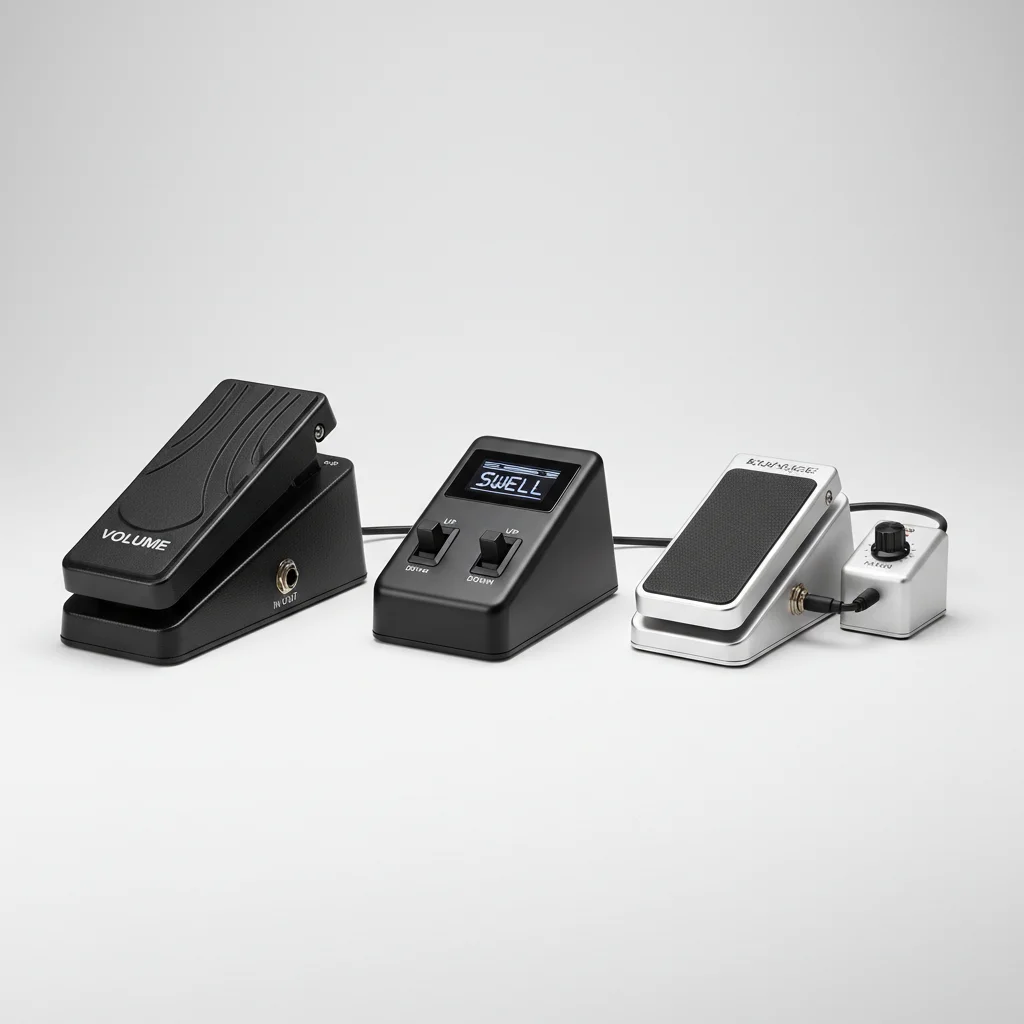
Choosing the right electric guitar volume pedal is crucial for achieving smooth, expressive swells and dynamic control. There are primarily three types of volume pedals available: passive, active, and optical. Each type offers distinct advantages and disadvantages in terms of tone preservation, power requirements, and overall feel, making the ‘best’ choice dependent on your specific needs and rig.
Passive Volume Pedals: Simplicity and Tone
Passive volume pedals are the most straightforward type, requiring no external power. They typically use a potentiometer to control the signal level. Their main appeal lies in their simplicity and the fact that they don’t introduce any additional circuitry that could potentially alter your tone. However, a common drawback is ‘tone suck,’ especially when placed early in the signal chain, as they can load your pickups and reduce high-end frequencies. This effect is more pronounced with high-impedance passive pedals. For optimal performance, many guitarists prefer to place passive pedals after buffered pedals or in an effects loop.
Active Volume Pedals: Consistent Signal and Features
Active volume pedals require external power, usually a 9V power supply. This power allows them to incorporate a buffer circuit, which helps maintain signal integrity and prevent tone loss, regardless of their position in the signal chain. Active pedals often offer additional features such as minimum volume controls, tuner outputs, and even boost functions. While they provide a more consistent signal, some purists argue that the added circuitry can subtly color the tone. They are an excellent choice for complex pedalboards where signal degradation is a concern.
Optical Volume Pedals: Smoothness and Durability
|
Our Picks for the Best Electric Guitar in 2026
As an Amazon Associate I earn from qualifying purchases.
|
||
| Num | Product | Action |
|---|---|---|
| 1 | Tostar 39 Inch Full Size Electric Guitar Kit For Beginners And Adults,SSS Pickup Stratocaster Guitarra Electrica Set Includes Tremolo Bridge,Amp,Strings,Stand,Case Bag, Birthday Holiday Gifts, Red |

|
| 2 | Jackson Dinky Minion JS1X Electric Guitar - Black |
|
| 3 | RockJam Electric Guitar Kit with 10-Watt Amp, Gig Bag, Picks, Spare Strings & Lessons |
|
| 4 | 16inch Mini Guitar Toy for Kids and Beginners, Electric Guitar with Strap for Toddlers and Boys and Girls Instrument Toys |
|
| 5 | Ibanez GRG131DX - Black Flat |
|
| 6 | LyxPro 39 inch Electric Guitar Kit Bundle with 20w Amplifier, All Accessories, Digital Clip On Tuner, Six Strings, Two Picks, Tremolo Bar, Shoulder Strap, Case Bag Starter kit Full Size - Blue |
|
| 7 | WINZZ EGM100 30 Inches Real Kids Electric Guitar with Beginner Kit, Right Handed (Gradient Pink) |
|
| 8 | STRICH Electric Guitar Beginner Kit, Solid Body 39" Full Size Electric Guitar HSS Pick Up for Starter, with 10W Amp, Bag, Digital Tuner, Capo, Strap, String,Cable, Picks, SST-S20 Sapphire Blue |
|
| 9 | 39 Inch Electric Guitar Bag 7mm Padding Waterproof Electric Guitar Case, Electric Guitar Gig Bag Backpack with Neck Strap and Pockets, Black |
|
| 10 | Fender Mini Stratocaster Electric Guitar Kit, Beginner Guitar Kit, with 2-Year Warranty, with Frontman 10G Amp, Padded Gig Bag, Strap, Cable, Tuner, and Picks, Daphne Blue |
|
Optical volume pedals utilize a light source and a light sensor to control the signal, rather than a physical potentiometer. This design eliminates mechanical wear and tear, making them highly durable and less prone to crackle or noise over time. The optical mechanism also tends to provide an exceptionally smooth and linear sweep, which is ideal for precise volume swells. Like active pedals, most optical pedals require power and often include buffering. They are generally considered a premium option due to their smooth operation and longevity, though they can be more expensive.
Choosing the Right Volume Pedal for Your Needs
When selecting an electric guitar volume pedal, consider your existing setup and desired outcomes. If you prioritize simplicity and a direct signal path, and are mindful of placement, a passive pedal might suffice. For those with extensive pedalboards or who want to ensure signal integrity, an active pedal offers excellent buffering and features. If ultimate smoothness, durability, and precise swells are your top priorities, an optical pedal is likely the best investment. Always test different types with your specific guitar and amplifier to hear how they interact with your unique sound.
- Consider your pedalboard’s complexity and signal chain.
- Evaluate whether tone preservation or added features are more important.
- Determine if you prefer a mechanical or optical sweep feel.
- Check for compatibility with your power supply and other pedals.
- Read user reviews for specific models to gauge reliability.
Recommended Volume Pedal Models
For guitarists seeking a reliable passive option, the Ernie Ball VP Jr. 250k is a perennial favorite, known for its robust build and smooth operation.If an active pedal with buffering and extra features is more your style, the Boss FV-500H (high impedance) or FV-500L (low impedance) offers versatility and durability.For those who demand the ultimate in smooth, quiet operation and longevity, the Electro-Harmonix Volume Pedal (active/optical) provides an excellent solution, ensuring your swells are always pristine.

I’ve been using a passive volume pedal for years, and while I love the simplicity, I’ve definitely noticed that ‘tone suck’ when it’s early in my chain. After reading about the active pedals here, I decided to try one out. The difference is night and day! My high end is back, and the swells are so much smoother without any signal loss. Definitely worth the investment for a cleaner sound.
I picked up an optical volume pedal hoping for super smooth operation, and it mostly delivers on that front. The feel is great for subtle swells, but I’ve found it a bit too sensitive for really quick, dramatic volume changes. It takes some getting used to, and sometimes I miss the more immediate response of a traditional pot. Good for certain styles, but not a universal solution for me.
This really clarified the different types of volume pedals. I always just grabbed whatever was cheapest, but understanding how each type affects tone and power makes a huge difference. I’m now looking at an active pedal specifically for its tone preservation, especially since I run a lot of effects before my volume pedal. Great insights!
I was on the fence about upgrading my old volume pedal, but the breakdown of passive vs. active really helped. I ended up going with an active pedal, and it’s fantastic for my ambient swells. The only reason it’s not a 5-star is that I wish I’d known about the power requirements beforehand; it added another plug to my already crowded power supply. Still, the performance is top-notch.