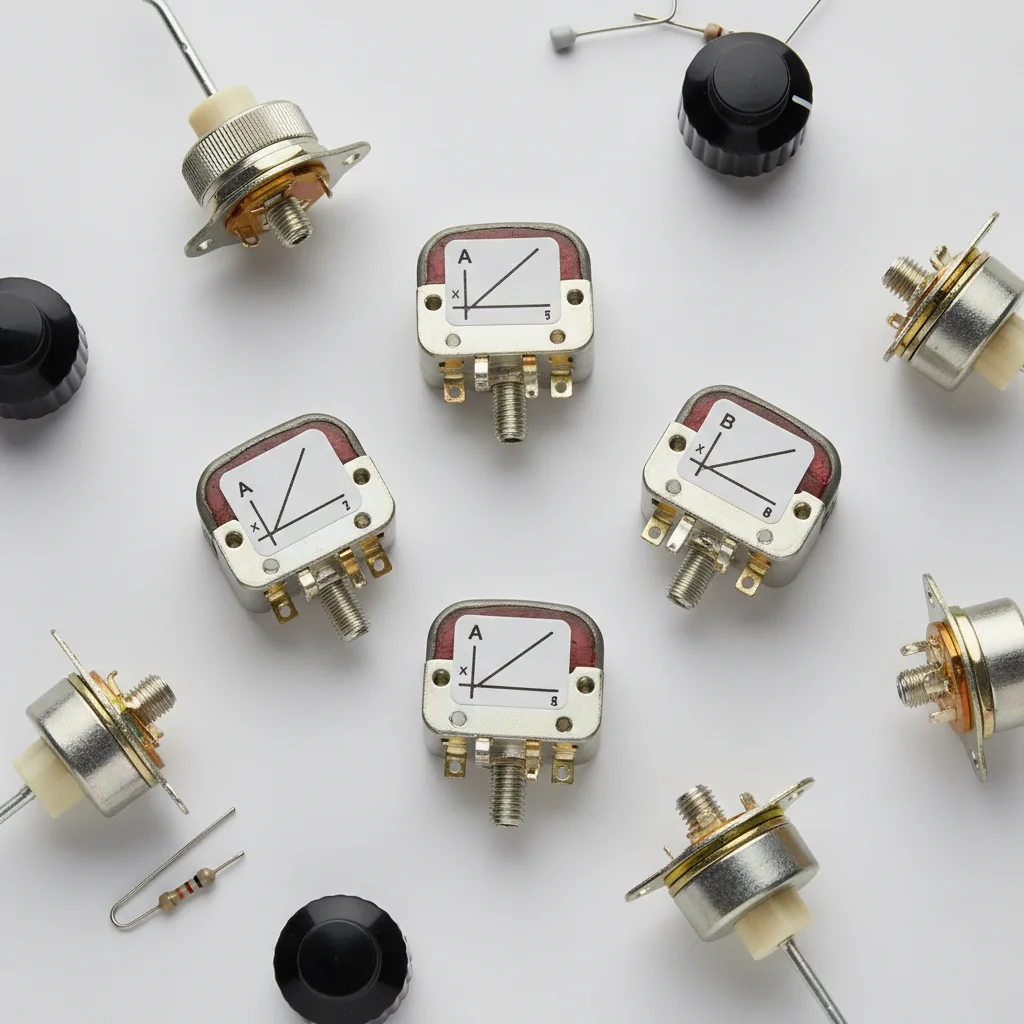
Electric guitar pots, or potentiometers, are crucial for controlling volume and tone. The taper of a pot dictates how the resistance changes as you turn the knob, directly impacting the feel and responsiveness of your guitar’s controls. For volume control, the best taper is typically a logarithmic (audio) taper, often designated as ‘A’ on the pot, because it mimics the human ear’s non-linear perception of loudness, providing a smoother and more natural volume sweep.
Understanding Potentiometer Tapers
Potentiometers come in various tapers, but the two most common for electric guitars are linear (B taper) and logarithmic (A taper). A linear taper changes resistance uniformly across its rotation, meaning a 50% turn results in 50% resistance. While this might seem intuitive, it doesn’t translate well to how we hear volume. The human ear perceives sound intensity logarithmically, not linearly.
A logarithmic taper, on the other hand, changes resistance more slowly at the beginning of its rotation and more rapidly towards the end. This design is specifically engineered to match the ear’s response, making volume adjustments feel more gradual and usable across the entire range of the knob. This is why ‘audio taper’ is the preferred choice for volume controls on most electric guitars.
Why Logarithmic Taper Excels for Volume
When you use a linear taper for volume, you often find that most of the audible change happens within a small portion of the knob’s rotation, typically between 7 and 10. Below that, the volume drops off very quickly, making fine adjustments difficult. With a logarithmic taper, the volume change is distributed more evenly, allowing for nuanced control from silent to full volume. This provides a much more musical and intuitive experience for players.
Consider the scenario of rolling off your volume for a cleaner sound or to manage feedback. A logarithmic pot allows for precise, subtle reductions, whereas a linear pot might jump from loud to nearly off with a slight turn. This precision is invaluable for dynamic playing and live performance.
Linear Taper Applications in Guitars
|
Our Picks for the Best Electric Guitar in 2026
As an Amazon Associate I earn from qualifying purchases.
|
||
| Num | Product | Action |
|---|---|---|
| 1 | WINZZ EGM100 30 Inches Real Kids Electric Guitar with Beginner Kit, Right Handed (Gradient Pink) |

|
| 2 | 16inch Mini Guitar Toy for Kids and Beginners, Electric Guitar with Strap for Toddlers and Boys and Girls Instrument Toys |
|
| 3 | RockJam Electric Guitar Kit with 10-Watt Amp, Gig Bag, Picks, Spare Strings & Lessons |
|
| 4 | 39 Inch Electric Guitar Bag 7mm Padding Waterproof Electric Guitar Case, Electric Guitar Gig Bag Backpack with Neck Strap and Pockets, Black |
|
| 5 | STRICH Electric Guitar Beginner Kit, Solid Body 39" Full Size Electric Guitar HSS Pick Up for Starter, with 10W Amp, Bag, Digital Tuner, Capo, Strap, String,Cable, Picks, SST-S20 Sapphire Blue |
|
| 6 | Tostar 39 Inch Full Size Electric Guitar Kit For Beginners And Adults,SSS Pickup Stratocaster Guitarra Electrica Set Includes Tremolo Bridge,Amp,Strings,Stand,Case Bag, Birthday Holiday Gifts, Red |
|
| 7 | Ibanez GRG131DX - Black Flat |
|
| 8 | Fender Mini Stratocaster Electric Guitar Kit, Beginner Guitar Kit, with 2-Year Warranty, with Frontman 10G Amp, Padded Gig Bag, Strap, Cable, Tuner, and Picks, Daphne Blue |
|
| 9 | LyxPro 39 inch Electric Guitar Kit Bundle with 20w Amplifier, All Accessories, Digital Clip On Tuner, Six Strings, Two Picks, Tremolo Bar, Shoulder Strap, Case Bag Starter kit Full Size - Blue |
|
| 10 | Jackson Dinky Minion JS1X Electric Guitar - Black |
|
While logarithmic tapers are ideal for volume, linear tapers do have their place in electric guitars, most commonly for tone controls. For tone circuits, a linear response can sometimes be more desirable, as it allows for a more direct and predictable sweep of the frequency cut-off. However, even for tone, some players prefer an audio taper for a smoother, more gradual effect, depending on their specific tonal goals and the circuit design.
It’s also worth noting that some guitarists experiment with linear pots for volume, particularly those who primarily use their volume knob as an on/off switch or who prefer a very quick drop-off. However, for general playability and nuanced control, the audio taper remains the standard recommendation.
Choosing the Right Pot Value and Taper
Beyond the taper, the resistance value of the potentiometer (e.g., 250k, 500k, 1M) is also critical and should be matched to your pickups. Single-coil pickups typically pair well with 250k pots, while humbuckers often benefit from 500k or even 1M pots to retain high-end clarity. The combination of the correct value and the appropriate taper is key to optimizing your guitar’s electronics.
- For single-coil pickups, use 250k audio taper pots for volume.
- For humbucker pickups, use 500k audio taper pots for volume.
- Experiment with linear or audio taper for tone controls based on preference.
- Always ensure the pot shaft type (solid, split) matches your knobs.
- Consider mini pots for tight cavities or push/pull pots for extra switching options.
When upgrading or replacing your guitar’s pots, always verify the existing values and tapers if you’re happy with the current feel, or choose new ones based on your desired outcome. High-quality pots can make a noticeable difference in the responsiveness and longevity of your controls.
Installation Tips and Common Issues
Installing new potentiometers requires basic soldering skills. Ensure you have the correct tools, including a soldering iron, solder, and wire cutters. Pay close attention to the wiring diagram for your specific guitar model to ensure proper connections. Incorrect wiring can lead to issues like hum, no sound, or reversed control functionality.
Common issues with pots include scratchy sounds when turned, which often indicates dirt or wear, and complete failure, where the control stops working altogether. In many cases, a simple replacement can resolve these problems. Always test your connections thoroughly before reassembling your guitar.

While the info on logarithmic taper for volume is solid, I still find that some ‘A’ pots can feel a bit too bunched up at the end of the sweep. It’s better than a linear taper for sure, but I wish there was a more gradual option for the last 20% of the rotation. Maybe it’s just my playing style.
Great breakdown of the different tapers. I’ve been using linear pots for years without really thinking about it, just assumed that’s how they were. The point about the human ear’s perception of loudness really clicked for me. I’m definitely going to try an A taper on my next build to see if it improves the volume sweep.
Finally, a clear explanation of why my volume knob felt so weird on my old Les Paul! I never understood the ‘A’ vs ‘B’ designation, but the detail about how a linear taper doesn’t translate well to how we hear volume is super helpful. I’m ordering some new pots today to upgrade my current setup.
I always wondered why some of my guitars felt so ‘on or off’ with the volume. This explanation about logarithmic (audio) taper pots makes so much sense now. Swapped out a linear pot on my Strat for an A taper, and the difference is night and day. Much smoother control, especially for those subtle clean-up tones.