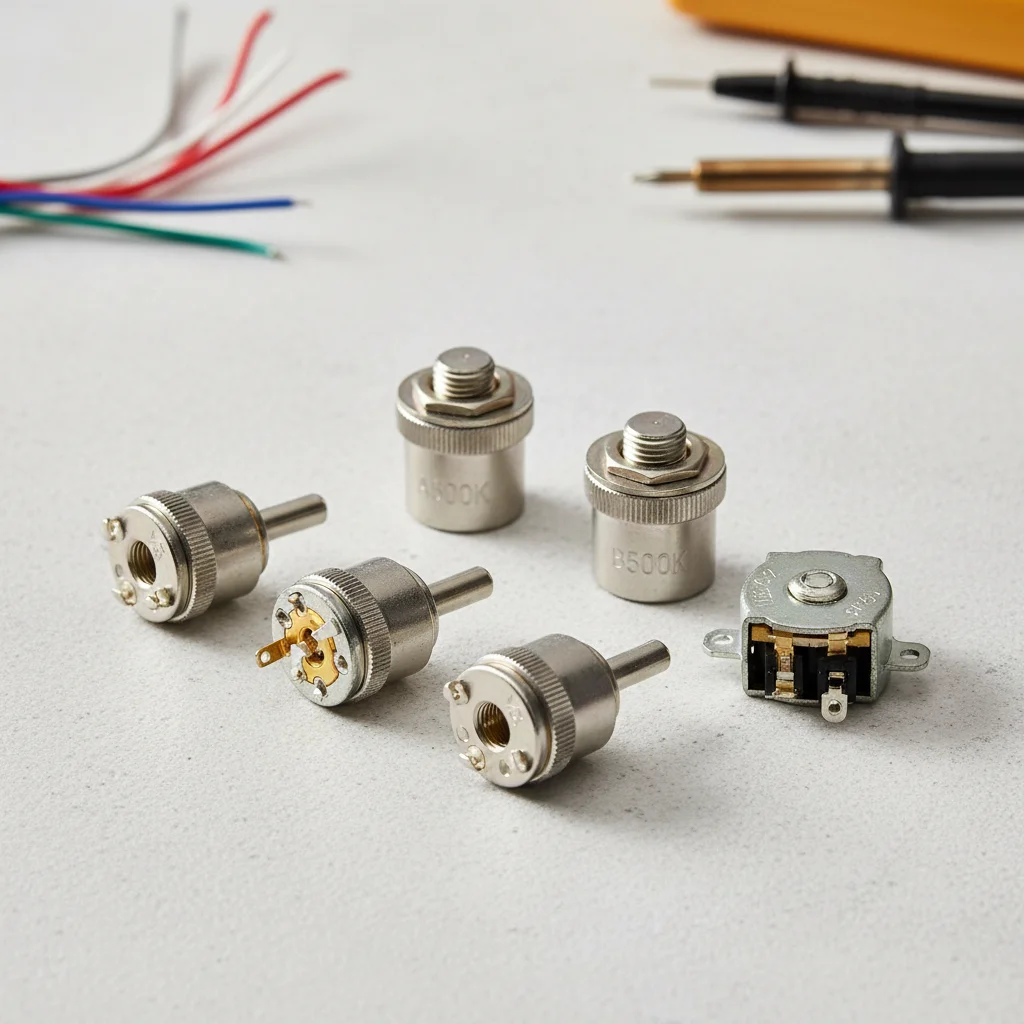
Understanding electric guitar pots is crucial for customizing your instrument’s response. There are primarily two types of pot tapers used in electric guitars: linear (B taper) and audio/logarithmic (A taper). The choice between these significantly impacts how your volume and tone controls behave, offering different experiences for players seeking precise adjustments or smooth, gradual changes.
Linear Taper Pots: Predictable Control
Linear taper pots, often designated with a ‘B’ (e.g., B500k), provide a resistance change that is directly proportional to the rotation of the knob. This means that if you turn the knob halfway, the resistance will be approximately half of its maximum value. For volume controls, this can feel very direct, with a noticeable change in loudness throughout the entire sweep. Some players prefer linear pots for volume, especially those who want a consistent and predictable response across the entire range, making it easier to dial in specific levels.
However, when used for tone controls, a linear taper might not always feel ideal. The human ear perceives volume and tone changes logarithmically, not linearly. This can result in tone controls feeling like they do most of their work at one end of the sweep, with less perceived change in the middle.
Audio Taper Pots: Natural Sound Progression
Audio taper pots, typically marked with an ‘A’ (e.g., A500k), are designed to mimic the logarithmic way the human ear perceives sound. This means the resistance changes more slowly at the beginning of the knob’s rotation and then more rapidly towards the end. For volume controls, this translates to a smoother, more gradual increase or decrease in perceived loudness, making it easier to find subtle nuances in your playing dynamics. Most guitar manufacturers use audio taper pots for volume controls due to this more natural feel.
Similarly, for tone controls, audio taper pots offer a more usable and musical sweep. The perceived change in tone is more evenly distributed across the knob’s rotation, allowing for finer adjustments to your sound. This makes them the preferred choice for most tone circuits, providing a more intuitive and expressive control over your guitar’s timbre.
Choosing the Right Potentiometer Value
|
Our Picks for the Best Electric Guitar in 2026
As an Amazon Associate I earn from qualifying purchases.
|
||
| Num | Product | Action |
|---|---|---|
| 1 | Fender Mini Stratocaster Electric Guitar Kit, Beginner Guitar Kit, with 2-Year Warranty, with Frontman 10G Amp, Padded Gig Bag, Strap, Cable, Tuner, and Picks, Daphne Blue |

|
| 2 | 16inch Mini Guitar Toy for Kids and Beginners, Electric Guitar with Strap for Toddlers and Boys and Girls Instrument Toys |
|
| 3 | WINZZ EGM100 30 Inches Real Kids Electric Guitar with Beginner Kit, Right Handed (Gradient Pink) |
|
| 4 | Jackson Dinky Minion JS1X Electric Guitar - Black |
|
| 5 | STRICH Electric Guitar Beginner Kit, Solid Body 39" Full Size Electric Guitar HSS Pick Up for Starter, with 10W Amp, Bag, Digital Tuner, Capo, Strap, String,Cable, Picks, SST-S20 Sapphire Blue |
|
| 6 | Tostar 39 Inch Full Size Electric Guitar Kit For Beginners And Adults,SSS Pickup Stratocaster Guitarra Electrica Set Includes Tremolo Bridge,Amp,Strings,Stand,Case Bag, Birthday Holiday Gifts, Red |
|
| 7 | 39 Inch Electric Guitar Bag 7mm Padding Waterproof Electric Guitar Case, Electric Guitar Gig Bag Backpack with Neck Strap and Pockets, Black |
|
| 8 | RockJam Electric Guitar Kit with 10-Watt Amp, Gig Bag, Picks, Spare Strings & Lessons |
|
| 9 | LyxPro 39 inch Electric Guitar Kit Bundle with 20w Amplifier, All Accessories, Digital Clip On Tuner, Six Strings, Two Picks, Tremolo Bar, Shoulder Strap, Case Bag Starter kit Full Size - Blue |
|
| 10 | Ibanez GRG131DX - Black Flat |
|
Beyond the taper, the resistance value of the pot (e.g., 250k, 500k, 1M) also plays a critical role. Generally, 250k pots are favored for single-coil pickups, as they provide a slightly warmer tone by rolling off some high frequencies. For humbuckers, 500k pots are more common, allowing more high-end frequencies to pass through, resulting in a brighter and more articulate sound. Some players even experiment with 1M pots for an even brighter, more open tone, particularly with darker-sounding pickups or for specific genres.
- 250k Pots: Ideal for single-coil pickups, offering a warmer tone.
- 500k Pots: Standard for humbuckers, providing a brighter, more articulate sound.
- 1M Pots: Used for maximum brightness, often with darker pickups or specific tonal goals.
- Experimentation: Don’t be afraid to try different values to find your preferred sound.
- Quality Matters: Invest in high-quality pots for reliable performance and longevity.
Installation and Replacement Tips
Replacing or upgrading your guitar’s pots is a common modification that can significantly impact your sound. When soldering, ensure you use a good quality soldering iron and appropriate solder. Pay attention to the wiring diagram for your specific guitar and pickup configuration. Incorrect wiring can lead to issues like hum, signal loss, or controls not functioning as intended. If you’re unsure, consulting a qualified guitar technician is always a good idea. Many online resources and forums offer detailed guides and support for DIY enthusiasts.
Consider upgrading to higher-quality pots like those from CTS or Alpha for improved durability and smoother operation.These brands are known for their consistent performance and robust construction, which can withstand years of use.Always double-check the shaft type (solid vs. split) and diameter to ensure compatibility with your existing knobs.
Final Considerations for Your Setup
The interaction between your pots, pickups, and wiring can create a unique sonic fingerprint for your guitar. While audio taper pots are generally recommended for both volume and tone due to their natural feel, some players might prefer a linear taper for volume for a more immediate response. Experimentation is key to finding what works best for your playing style and desired sound. Don’t hesitate to try different combinations of pot values and tapers to truly dial in your electric guitar’s voice.

I always wondered why some of my guitars felt so different when I adjusted the volume. This really cleared up the distinction between linear and audio taper pots. Swapping out the linear pot on my Strat for an audio taper made a huge difference in how smoothly the volume rolls off. It’s much more usable now for those subtle swells.
Finally, a clear explanation of why my volume knob on my Les Paul feels so different from my Telecaster! The part about linear pots being ‘directly proportional’ really clicked for me. I’m definitely going to experiment with different tapers on my next build to get that perfect feel for both volume and tone.
Great info on the different pot tapers! I’ve been struggling with my tone control feeling like an on/off switch, and now I understand why. I’m definitely going to try a B taper pot for my tone knob to get a more consistent and predictable sweep. It’s a small change but sounds like it’ll make a big impact on my playing experience.
Good breakdown of A vs B taper pots. I tried a B500k linear pot for my volume control hoping for more precise adjustments, but it felt a bit too abrupt for my taste. I think I’ll stick with audio taper for volume in the future. Still, it was worth experimenting to see the difference firsthand.