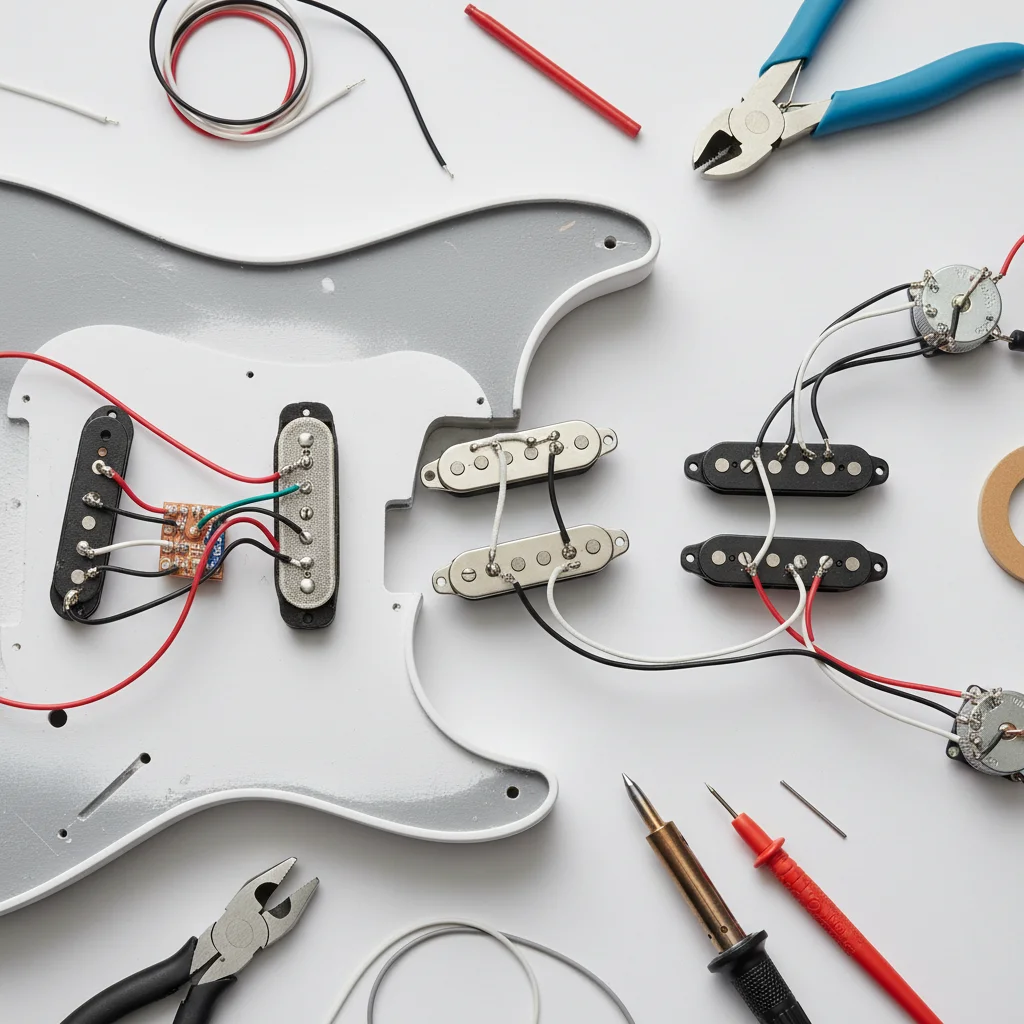
Understanding electric guitar pickup wiring configurations is crucial for shaping your sound, and there are five primary setups that guitarists commonly utilize. These configurations dictate how your pickups interact, influencing everything from hum cancellation to tonal versatility. Choosing the right wiring can dramatically alter your guitar’s sonic character, allowing you to achieve a wider range of tones or hone in on a specific sound.
Single-Coil Wiring: Brightness and Clarity
Single-coil pickups are known for their bright, clear, and articulate tone. The most basic wiring involves connecting a single-coil pickup directly to the volume and tone controls. This setup is common in Fender Stratocasters and Telecasters, offering that classic, chimey sound. While they excel in clarity, single-coils are susceptible to 60-cycle hum, which can be a concern in certain environments. Many players embrace this characteristic as part of the single-coil charm, especially for genres like blues, country, and surf rock.
Humbucker Wiring: Power and Hum Cancellation
Humbuckers, invented to combat the hum of single-coils, achieve this by using two coils wired out of phase. The standard humbucker wiring connects both coils in series, resulting in a fatter, higher-output sound with excellent hum cancellation. This configuration is a staple in rock, metal, and jazz, providing a thick tone with strong sustain. Guitars like Gibson Les Pauls are famous for their humbucker-driven sound. The series wiring boosts the output and often provides a warmer, more compressed tone compared to single-coils.
Series/Parallel Wiring: Versatility for Humbuckers
For humbuckers, series/parallel wiring offers a significant increase in tonal options. In series mode, the two coils are connected end-to-end, providing the traditional high-output, thick humbucker sound. In parallel mode, the coils are wired side-by-side, resulting in a lower output, brighter, and more single-coil-like tone, but still with hum cancellation. This configuration is often achieved with a push/pull pot or a mini-toggle switch, making it a popular modification for players seeking greater versatility from their humbuckers. It’s an excellent way to get both powerful and articulate sounds from a single pickup.
- Standard Series Humbucker: Full, thick, high output.
- Parallel Humbucker: Brighter, lower output, hum-cancelling.
- Coil Split: True single-coil tone, susceptible to hum.
- Phase Switching: Creates unique, hollow, out-of-phase sounds.
- Series/Parallel for Single-Coils: Boosts output and midrange.
Coil Splitting: Single-Coil Tones from Humbuckers
|
Our Picks for the Best Electric Guitar in 2026
As an Amazon Associate I earn from qualifying purchases.
|
||
| Num | Product | Action |
|---|---|---|
| 1 | LyxPro 39 inch Electric Guitar Kit Bundle with 20w Amplifier, All Accessories, Digital Clip On Tuner, Six Strings, Two Picks, Tremolo Bar, Shoulder Strap, Case Bag Starter kit Full Size - Blue |

|
| 2 | Fender Mini Stratocaster Electric Guitar Kit, Beginner Guitar Kit, with 2-Year Warranty, with Frontman 10G Amp, Padded Gig Bag, Strap, Cable, Tuner, and Picks, Daphne Blue |
|
| 3 | WINZZ EGM100 30 Inches Real Kids Electric Guitar with Beginner Kit, Right Handed (Gradient Pink) |
|
| 4 | Tostar 39 Inch Full Size Electric Guitar Kit For Beginners And Adults,SSS Pickup Stratocaster Guitarra Electrica Set Includes Tremolo Bridge,Amp,Strings,Stand,Case Bag, Birthday Holiday Gifts, Red |
|
| 5 | STRICH Electric Guitar Beginner Kit, Solid Body 39" Full Size Electric Guitar HSS Pick Up for Starter, with 10W Amp, Bag, Digital Tuner, Capo, Strap, String,Cable, Picks, SST-S20 Sapphire Blue |
|
| 6 | Jackson Dinky Minion JS1X Electric Guitar - Black |
|
| 7 | Ibanez GRG131DX - Black Flat |
|
| 8 | 39 Inch Electric Guitar Bag 7mm Padding Waterproof Electric Guitar Case, Electric Guitar Gig Bag Backpack with Neck Strap and Pockets, Black |
|
| 9 | RockJam Electric Guitar Kit with 10-Watt Amp, Gig Bag, Picks, Spare Strings & Lessons |
|
| 10 | 16inch Mini Guitar Toy for Kids and Beginners, Electric Guitar with Strap for Toddlers and Boys and Girls Instrument Toys |
|
Coil splitting is a popular wiring modification that allows a humbucker to operate as a single-coil pickup. This is typically done by grounding one of the humbucker’s coils, effectively turning off one half of the pickup. The result is a brighter, lower-output tone similar to a true single-coil, though it will reintroduce the 60-cycle hum. This feature is highly valued by guitarists who want the best of both worlds – the power of a humbucker and the chime of a single-coil – in a single instrument. Many modern guitars come with coil-splitting capabilities built-in, often activated by a push/pull tone or volume knob.
Phase Switching: Unique Tonal Textures
Phase switching involves reversing the polarity of one pickup relative to another. When two pickups are wired out of phase, they produce a thin, hollow, and often nasal tone. This unique sound is famously associated with Brian May of Queen and is particularly effective when both pickups are engaged. While not a primary tone for most, it offers a distinct sonic texture that can be incredibly useful for specific musical passages or experimental sounds. It’s a more advanced wiring option that can add a surprising dimension to your guitar’s palette.
Series Wiring for Single-Coils: Boosting Output
While less common than with humbuckers, single-coil pickups can also be wired in series. When two single-coils are wired in series, their output is combined, resulting in a fatter, higher-output tone that approaches humbucker territory. This configuration also offers some hum cancellation when both pickups are engaged. It’s a great way to get more power and sustain from a single-coil equipped guitar without resorting to humbuckers, offering a unique blend of single-coil clarity with added punch. This modification is often found in custom wiring schemes or specific boutique instruments.
