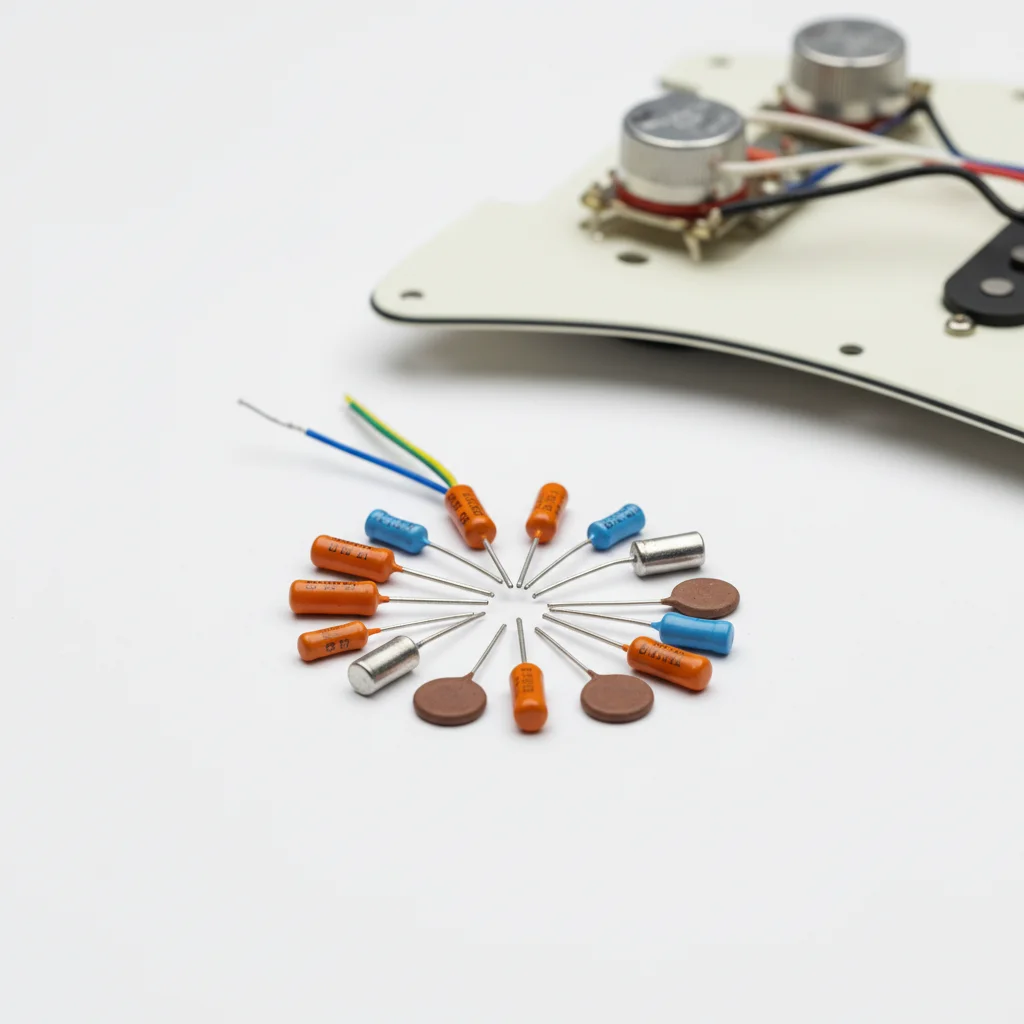
Electric guitar capacitors play a crucial role in shaping your instrument’s tone, primarily by filtering out high frequencies. While often overlooked, these small components can significantly alter the character of your sound, especially when interacting with your guitar’s tone knob. Understanding their function and how different types and values impact your signal is key to fine-tuning your guitar’s sonic output.
What Do Capacitors Do in an Electric Guitar?
In an electric guitar’s wiring, capacitors are typically found in the tone circuit. When you roll back your tone knob, the capacitor diverts certain high frequencies to ground, effectively ‘cutting’ them from your signal. This allows you to achieve warmer, darker tones. Without a capacitor, your tone knob would simply act as an on/off switch for the tone circuit, offering no gradual control over the high-frequency rolloff. The capacitor’s value, measured in microfarads (µF) or nanofarads (nF), determines which frequencies are affected and to what extent.
Common Capacitor Types and Their Tonal Impact
Several types of capacitors are used in electric guitars, each with slightly different sonic characteristics, though the audible differences are often subtle and debated among players. The most common types include ceramic, polyester (Mylar), and polypropylene. Ceramic capacitors are often found in budget-friendly guitars and are known for a somewhat abrupt high-frequency rolloff. Polyester capacitors, like Orange Drop, are popular for their smooth, gradual tone sweep. Polypropylene capacitors are also favored for their transparency and consistent performance. While the material itself can influence the ‘feel’ of the tone control, the capacitance value is the primary factor in determining the actual frequency cutoff point.
Capacitance Values and Tone Shaping
|
Our Picks for the Best Electric Guitar in 2026
As an Amazon Associate I earn from qualifying purchases.
|
||
| Num | Product | Action |
|---|---|---|
| 1 | LyxPro 39 inch Electric Guitar Kit Bundle with 20w Amplifier, All Accessories, Digital Clip On Tuner, Six Strings, Two Picks, Tremolo Bar, Shoulder Strap, Case Bag Starter kit Full Size - Blue |

|
| 2 | Jackson Dinky Minion JS1X Electric Guitar - Black |
|
| 3 | 16inch Mini Guitar Toy for Kids and Beginners, Electric Guitar with Strap for Toddlers and Boys and Girls Instrument Toys |
|
| 4 | Fender Mini Stratocaster Electric Guitar Kit, Beginner Guitar Kit, with 2-Year Warranty, with Frontman 10G Amp, Padded Gig Bag, Strap, Cable, Tuner, and Picks, Daphne Blue |
|
| 5 | STRICH Electric Guitar Beginner Kit, Solid Body 39" Full Size Electric Guitar HSS Pick Up for Starter, with 10W Amp, Bag, Digital Tuner, Capo, Strap, String,Cable, Picks, SST-S20 Sapphire Blue |
|
| 6 | RockJam Electric Guitar Kit with 10-Watt Amp, Gig Bag, Picks, Spare Strings & Lessons |
|
| 7 | WINZZ EGM100 30 Inches Real Kids Electric Guitar with Beginner Kit, Right Handed (Gradient Pink) |
|
| 8 | Ibanez GRG131DX - Black Flat |
|
| 9 | Tostar 39 Inch Full Size Electric Guitar Kit For Beginners And Adults,SSS Pickup Stratocaster Guitarra Electrica Set Includes Tremolo Bridge,Amp,Strings,Stand,Case Bag, Birthday Holiday Gifts, Red |
|
| 10 | 39 Inch Electric Guitar Bag 7mm Padding Waterproof Electric Guitar Case, Electric Guitar Gig Bag Backpack with Neck Strap and Pockets, Black |
|
The value of a capacitor is the most significant factor in how it affects your guitar’s tone. Common values for electric guitars range from 0.015µF to 0.047µF. A lower value, such as 0.015µF, will remove fewer high frequencies, resulting in a brighter tone when the tone knob is rolled off. Conversely, a higher value, like 0.047µF, will cut more highs, leading to a darker, warmer sound. For example, a 0.022µF capacitor is a very common choice for humbucker-equipped guitars, offering a balanced tone rolloff, while single-coil guitars often use 0.047µF for a more pronounced darkening effect. Experimenting with different values is a common modification for players seeking to customize their sound.
- 0.015µF: Subtle high-frequency rolloff, brighter tone.
- 0.022µF: Standard for humbuckers, balanced tone control.
- 0.033µF: Slightly darker than 0.022µF, good for single-coils.
- 0.047µF: Standard for single-coils, pronounced dark tone.
- 0.1µF: Very dark, often used for bass guitars or specific vintage tones.
How to Choose the Right Capacitor for Your Guitar
Choosing the right capacitor involves considering your guitar’s pickups, your playing style, and the specific tonal range you desire. If you find your guitar’s tone too bright, a higher capacitance value might be beneficial. If you prefer a more subtle tone rolloff, a lower value is appropriate. Many guitarists start with the standard values for their pickup type (e.g., 0.022µF for humbuckers, 0.047µF for single-coils) and then experiment from there. It’s a relatively inexpensive and reversible modification that can yield significant sonic results. Consider trying a few different values to hear the impact firsthand.
Installation and Experimentation Tips
Replacing a capacitor is a straightforward process for anyone with basic soldering skills. Always ensure your guitar is unplugged and the strings are loosened before opening the control cavity. When soldering, use a low-wattage iron to avoid damaging components. It’s a good idea to test the new capacitor before fully reassembling your guitar. Many online resources and guitar tech videos can guide you through the process. Don’t be afraid to experiment with different types and values; the subtle nuances can make a big difference in your overall sound.
